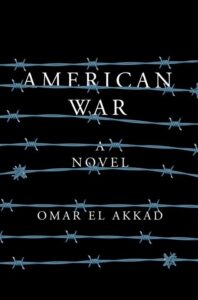
 Published: 2017
Genres: Fiction, Dystopia, Political Fiction, Environment, War
Grade Levels: Adult
Content Warnings: Graphic violence, torture, suicide, strong language
Goodreads Link: American War
Publisher’s Summary:
Nominee for Readers’ Favorite Science Fiction (2017), Nominee for Readers’ Favorite Debut Goodreads Author (2017)
An audacious and powerful debut novel: a second American Civil War, a devastating plague, and one family caught deep in the middle a story that asks what might happen if America were to turn its most devastating policies and deadly weapons upon itself
Sarat Chestnut, born in Louisiana, is only six when the Second American Civil War breaks out in 2074. But even she knows that oil is outlawed, that Louisiana is half underwater, and that unmanned drones fill the sky. When her father is killed and her family is forced into Camp Patience for displaced persons, she begins to grow up shaped by her particular time and place. But not everyone at Camp Patience is who they claim to be. Eventually Sarat is befriended by a mysterious functionary, under whose influence she is turned into a deadly instrument of war. The decisions that she makes will have tremendous consequences not just for Sarat but for her family and her country, rippling through generations of strangers and kin alike.
Review:
On the heels of watching Alex Garland’s recent film Civil War (2024), I was eager to read Omar El Akkad’s American War, another unsettling look at a hypothetical second American Civil War. While both texts explore the human cost of conflict, Akkad’s novel stands out for its focus on American refugees and the extreme lengths displaced people go to survive and reclaim agency.
The novel’s most compelling strength is its worldbuilding, presenting a future United States fractured not only by civil war, but by environmental collapse and a deadly, quarantining plague. Published in 2017, its warnings about climate catastrophe and contagion feel eerily prophetic. Akkad’s narrative is unmistakably shaped by the Post-9/11 era, especially in its portrayal of the radicalization of ordinary civilians. One harrowing section—set in a prison compound reminiscent of Guantanamo Bay, including a brutal waterboarding scene—reinforces the book’s unflinching examination of state violence.
Through Sarat’s transformation, Akkad interrogates the origins of extremism and the generational consequences of war. The novel is stark, bold, and deeply haunting, forcing readers to confront the possibility that conflicts Americans assume can only happen elsewhere could, under the right pressures, unfold much closer to home.
Curricular Connections:
Useful for units on dystopian literature, environmental collapse, political extremism, global conflict, refugee studies, narrative perspectives in war literature, and analysis of post-9/11 themes. Strong anchor text for discussions about ethics, state power, radicalization, and the societal impact of climate change.