 Review By: Susan Collins
Published: 2018
Genres: Picture book, Nonfiction, Indigenous, Cultural
Audience: K-5, Elementary
Goodreads Link: We Are Grateful: Otsaliheliga
Content Warnings: none
Publisher’s Summary
The word otsaliheliga (oh-jah-LEE-hay-lee-gah) is used by members of the Cherokee Nation to express gratitude. Beginning in the fall with the new year and ending in summer, follow a full Cherokee year of celebrations and experiences. Written by a citizen of the Cherokee Nation, this look at one group of Native Americans is appended with a glossary and the complete Cherokee syllabary, originally created by Sequoyah.
“A gracious, warm, and loving celebration of community and gratitude”—Kirkus Reviews STARRED REVIEW “The book underscores the importance of traditions and carrying on a Cherokee way of life”—Horn Book STARRED REVIEW
Review
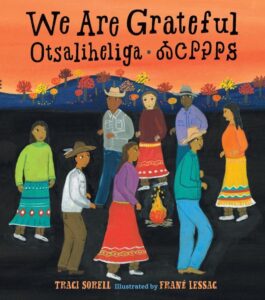
We Are Grateful: Otsaliheliga, written by Traci Sorell and illustrated by Frané Lessac, is a celebration of Cherokee culture, community, and the practice of gratitude throughout the year. “Otsaliheliga” (oh-jah-LEE-hay-lee-gah) means “we are grateful” in Cherokee, and this theme shapes every page of the book. Sorell, a citizen of the Cherokee Nation, offers reflection into modern Cherokee life. Rather than presenting Native cultures as part of the distant past, the book emphasizes that Cherokee traditions are living, evolving, and integrated into modern daily life.
Readers follow a Cherokee family across the four seasons, seeing how gratitude is expressed through food, family gatherings, ceremonies, community service, and connecting with the natural world. Frané Lessac’s illustrations are full of color and detail. They portray a sense of togetherness, making the book engaging for young readers. Every page feels lively and textured, showing both traditional activities and everyday moments.
In a simple, balanced, deep way, the walk through the seasons leads young readers through the seasons. The main text is accessible for young children, while the back matter includes additional explanations about Cherokee traditions, vocabulary, and cultural practices—making it an excellent resource for classrooms.
It provides authentic Native representation, celebrating gratitude as a year-round practice, not just a holiday theme. It supports conversations about community, heritage, and respect for nature in an elementary school classroom. The visuals and text together create a heartwarming reading experience. This is modern Native American life as told by an enrolled citizen of the Cherokee Nation.