 Review By: Jenna Ballard
School: Chittenango Middle School
Published: 2025
Genres: Nonfiction, History, Biography
Audience: Grades 7–9 (Middle Grade to Early YA)
Goodreads Link: At Last She Stood
Content Warnings: Descriptions of WWII violence, prisoners of war, and images of patients with Hansen’s Disease.
Publisher’s Summary
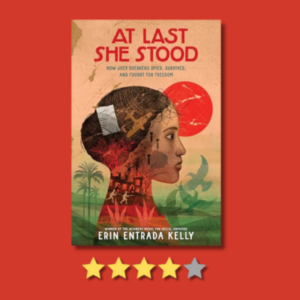
World War II spy, Filipino guerrilla fighter, war hero, Medal of Freedom recipient, leprosy survivor, teacher, peacemaker . . . The legendary and inspiring life and work of Josefina “Joey” Guerrero is introduced to readers by two-time Newbery Medal winner, National Book Award finalist, and bestselling author Erin Entrada Kelly. For fans of Steve Sheinkin and Candace Fleming.
Joey Guerrero, a native of the Philippines, was diagnosed with leprosy (Hansen’s disease) as World War II unfolded in Europe and Asia. Soon after the Japanese occupied the Philippines, Joey—believing she would die soon—joined the guerrilla movement to complete covert missions in support of the Allies. Because of her condition, she was rarely searched by Japanese soldiers, which allowed her to courier secret messages, including an invaluable minefield map that she taped to her back. She was eventually awarded the US Presidential Medal of Freedom and admitted to the National Leprosarium in Carville, Louisiana, where she lived for nine years. When she was cured and released, she found it difficult to find work because of racial discrimination and her health history and was forced to pawn her Presidential Medal to make ends meet. Eventually, she shed her previous identity. When she died in 1996, her obituary identified her as a secretary from Manila. But Joey Guerrero was much more than that—she was a hero who changed the course of history.
Erin Entrada Kelly’s engaging nonfiction debut combines themes of the Philippines, World War II, the Asia-Pacific War, spy stories, Louisiana, immigration, disease and medicine, racism, perseverance, religious devotion, and hope. Illustrated with photographs, maps, and other illustrative material and featuring sidebars that clearly illuminate key moments in history, At Last She Stood is for readers and educators who love Candace Fleming, Deborah Heiligman, Christina Soontornvat, and Steve Sheinkin. Includes an author’s note, source notes, index, and other back matter.
Review
At Last She Stood is the inspirational true story of a woman, Joey Guerrero, who carried out covert spy missions for Allied Forces during World War II. That alone would be enough for an engaging biography, yet Joey’s story is all the more impactful due to the fact that she lived with Hansen’s Disease, more commonly known as leprosy, for much of her life. She battled not only the physical symptoms of that disease, but the terrible stigma and isolation that came with it during the mid-twentieth century. Kelly writes about how Joey, deeply religious, seemed to accept her condition as a challenge God knew she could handle—and she certainly handled a lot.
One day, Joey demonstrates her bravery and spunk by standing up to a Japanese officer who harassed her and her friends on the street. This moment sparks an invitation for Joey to join the Filipino guerillas, who are working with the U.S. military against the Japanese. The rest is history—sort of. Although Joey was recognized for her service immediately after the war, her medical condition and racial discrimination presented major barriers and she eventually changed her name. Her name and sacrifices have been forgotten over time, until writer Erin Entrada Kelly tackled her biography.
Not many of my students choose to read narrative nonfiction, but this book has the potential to open the door to that genre for young readers. Of course, students who have an interest in World War II and/or military strategy would be a likely match for this book. I would also recommend it for students who were fans of the I Survived series and are now ready for something similar, yet a bit more challenging. At 165 pages, it’s not too intimidating. Kelly breaks down big, complicated topics into bite-sized chapters and sidebars to make them more digestible to young readers. The audiobook is an engaging and quick listen, though after flipping through a print book I noticed that I did miss out on many maps and photographs in the print version that surely enhance the reading experience.
Historical Context: The Filipino Resistance
The story of Joey Guerrero is part of a much larger, often overlooked movement. During the Japanese occupation of the Philippines (1942–1945), the resistance was massive and diverse:
- Total Recognized Guerrillas: Approximately 260,000 individuals were officially recognized by the US as part of the organized resistance, though modern historians estimate the total number of participants was much higher.
- The Hukbalahap: A significant group of nearly 30,000 armed fighters who engaged in over 1,200 skirmishes with Japanese forces.
- Intelligence Impact: The information provided by spies like Joey Guerrero was vital for General MacArthur’s return; by 1944, Allied intelligence in the Philippines was considered among the best in any occupied territory.
Curricular Connection: Medicine & Society
This biography is a rare and excellent resource for discussing Hansen’s Disease and Social Stigma:
- Science: Discuss the pathology of Mycobacterium leprae and the development of sulfone drugs (mentioned in the book) which eventually provided a cure.
- Ethics: Explore how “medical “labels” can lead to social exclusion, comparing the historical treatment of leprosy patients to other modern health crises.
- Identity: Discuss the intersection of race and disability—how Joey faced a double barrier when trying to find work in the U.S. after her recovery.