 Published: 2026
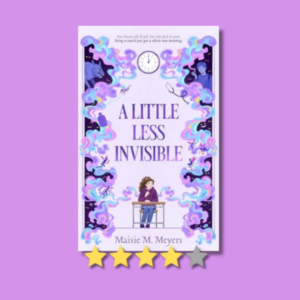
Author: Maisie M. Meyers
Genres: YA Fantasy, Magical Realism
Audience: Grades 6–8 (Middle School)
Number of Stars: ★★★★☆ (4/5)
Goodreads Link: A Little Less Invisible
Content Warnings: Chronic illness, pain, and brief mention of vaping.
Publisher’s Summary
One chronically ill girl.
Fae who feed on pain.
Being a snack just got a whole new meaning.
Sixteen-year-old Sedona “Seda” Gerard has one goal: stay in school and on track for her future. But chronic heart issues and pain make it feel like she’s getting rotisserie chicken roasted from the inside out. School administrators are trying to force her into the hospital-homebound program because of all her absences, and her doctors are stumped, unable to diagnose what’s wrong.
Then, right as she’s made a plan to outfox the administrators and avoid being sent home, fae monsters masquerading as humans—beings who feed on pain—hunt her down at school. Someone told the monsters about her. They crave her chronic pain—and worse, they want her trapped at home too, helpless, so they can feed without anyone noticing just like they did with the last chronically ill girl.
Nikolai Shaw is probably human and definitely Seda’s only hope for protecting herself as the fae close in. Too bad he’s prickly as a bundle of IV needles, with a smile that does funny things to whatever is wrong with her heart. But he knows about a weapon that can destroy the monsters for good. While he has a secret agenda of his own, he’s willing to help Seda get it, but they have to hurry—before the fae make a meal out of Seda and erase her from existence forever.
Teen Wolf meets Legendborn in this heart-pounding, romantic, and bitingly funny YA contemporary fantasy debut featuring a chronically ill girl, the fae who want to turn her into a meal, and the secretive but annoyingly cute boy she needs to help her stop them. Perfect for fans of Holly Black
Full Review
This book places you in the life of high school student Seda, a teen dealing with schoolwork, a cute boy, and parasitic fairies. Seda has a baffling combination of medical symptoms that cause her to be in pain daily. She faces supernatural creatures that say they want to help her relieve this pain… although they all have motives of their own.
Overall, I thought the setting and dialogue were engaging and appropriate for the story. I would recommend this book to middle school students, despite the main character being in high school. While her struggle with chronic illness is prevalent, the challenges Seda faces are never graphic or overly wretched; the story would have retained its integrity even if Seda were in 8th grade. This is not a horror story or a gripping mystery, but rather a character creating a unique world to cope with the unknown implications of her medical situation.
I appreciate this book for its representation of a student dealing with an unknown illness. That being said, I was not swept away by the secondary characters and felt they could have been more rounded. I also never truly felt any character was in serious peril, which reduced the tension. However, while I wasn’t on the edge of my seat, I was very satisfied with the ending. It is a meaningful and unique read for those struggling with illness or interested in fairy lore.
🧚 The “Pain-Eater” as a Fantasy Metaphor
In A Little Less Invisible, the fae serve as a powerful metaphor for the “invisibility” of chronic illness. Just as people in the real world might not see Seda’s internal pain, the fae monsters hide in plain sight, feeding on what others ignore.
🎒 Classroom & Curricular Connections
- Health (Chronic Illness Awareness): Use Seda’s story to discuss “Spoon Theory”—a popular metaphor used to explain the limited energy reserves of people living with chronic illness.
- ELA (Symbolism): Discuss why the author chose “parasitic fairies” to represent pain. How does personifying a medical condition help a character (or a reader) cope with it?
- Social Studies/Advocacy: Research the “Hospital-Homebound” programs mentioned in the book. Discuss the pros and cons of these programs for students with disabilities or long-term illnesses.
- Creative Writing: Have students write a scene from the perspective of a “symptom” or a “monster.” How does giving an illness a “voice” change the way we understand the person experiencing it?