 Published: 2025
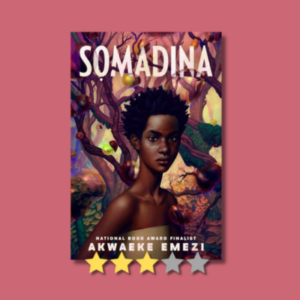
Author: Akwaeke Emezi
Genres: YA Fantasy, West African-Inspired Fantasy
Audience: Grades 9–12
Number of Stars: ★★★☆☆ (3/5)
Goodreads Link: Somadina
Content Warnings: Violence and death.
Publisher’s Summary
From the National Book Award finalist and author of Pet comes a novel set in a magical West African world, about a teen girl who must save her missing twin while learning to navigate her own terrifying new powers. Somadina and her twin brother, Jayaike, are practically the same person: they finish each other’s sentences and make each other whole. When the twins come of age, their magical gifts begin to develop, but while Jayaike’s powers enchant, Somadina’s cause fear to ripple through her town. Always an outsider, Somadina now faces blatant–and dangerous–hostility. And things go from bad to worse when her brother—the one person she trusted—vanishes. Somadina knows that no matter the dangers, she must track him down. Even if it means entering the Sacred Forest. Even if it means grueling, otherworldly travel she may not survive. Even if it means finding the hidden places where those closest to the spirit world don’t dare to go. Does Somadina have the strength — within both her body and her soul — for the trying journey ahead? National Book Award finalist Akwaeke Emezi masterfully weaves a tale of family, identity, and the power of the past, in a world where the extraordinary is ordinary.
Full Review
Somadina is the latest young adult novel by Akwaeke Emezi, who has crafted a vibrant, unnamed fantasy world reeling from “The Rift”—a magical catastrophe created two generations ago. In this world, magic typically manifests as young people come of age, but the title character and her twin, Jayaike, are late bloomers. When their powers finally arrive, the results are dramatic and polarizing. Somadina discovers her touch can kill, manifesting as a “force of emptiness,” while Jayaike’s power is one of “fullness” and life.
The plot kicks into high gear when a monster named Ejike kidnaps Jayaike to consume their combined powers. Somadina, alongside her friend and big sister, sets off on a rescue mission that is both action-packed and engaging. Every page features a new development, ensuring the story never drags. While it works well as a standalone fantasy with a satisfying resolution, Emezi leaves enough intriguing questions about the world’s lore that readers may hope for a sequel.
Though books with African-inspired settings sometimes move slowly off the shelves, students who give this a chance will likely enjoy the high stakes and the fascinating “opposite powers” dynamic between the twins. Emezi avoids simplistic explanations, leaving much of the magic’s nature up to the reader’s interpretation.
🌀 The Duality of Power: Emptiness vs. Fullness
The heart of the novel lies in the metaphysical balance between the two twins. Their powers represent a classic cosmological duality often found in West African mythology—the necessity of both destruction (emptiness) and creation (fullness). In the world of Somadina, the Dibia (priests/healers) are the traditional keepers of magical balance. The failure of the previous generation of Dibias to heal “The Rift” creates the unstable world the twins must now navigate.
🎒 Classroom & Curricular Connections
- ELA (Comparative Mythology): Research the role of twins (like the Ibeji in Yoruba culture) in West African mythology. How does Emezi use these cultural touchstones to build their fantasy world?
- Creative Writing (Magic Systems): Discuss the concept of “The Rift.” Have students write a “prequel” scene explaining the moment the world was separated. How does a “broken” setting affect the characters’ motivations?
- Social Studies (Cultural Settings): Use this book as an entry point to discuss West African geography and folklore. Analyze how “The Sacred Forest” serves as a Liminal Space—a threshold between the physical and spirit worlds.
- Art & Design: Based on Emezi’s vivid descriptions, have students design the visual representation of Somadina’s “Emptiness” and Jayaike’s “Fullness.” How do you draw “nothing” versus “everything”?