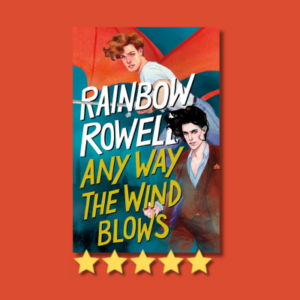
 Published: 2021
Author: Rainbow Rowell
Genres: YA Fantasy, Romance, LGBTQ+
Audience: Grade 12, Adult
Number of Stars: ★★★★★ (5/5)
Goodreads Link: Any Way the Wind Blows
Content Warnings: Maturity Leap: Contains significant sexual content (unlike books 1 and 2), depression, PTSD, kidnapping, cult themes, and racism.
Publisher’s Summary
Full Review
Any Way the Wind Blows is a triumphant, emotionally wrenching conclusion to the Simon Snow trilogy. However, a major disclaimer is necessary: while the first two books (Carry On and Wayward Son) are suitable for Grade 8 and up, this final installment features a significant jump in maturity. The introduction of explicit sexual content makes this a title better suited for older teens (11th–12th grade) and adults.
That said, the novel is an excellent study of identity. After losing his magic, Simon struggles with his place in a world that no longer fits him. He grapples with body image issues, a lack of power, and deep-seated insecurities. Rainbow Rowell excels at making her characters feel like real, multidimensional people. I particularly appreciated how she handled Agatha; rather than tossing the “ex-girlfriend” aside, Rowell maintains her as a vital, independent character, proving women are more than their relationship status.
The cast is beautifully diverse—spanning various ethnicities, religions, sexualities, and races—reflecting a world that feels both magical and authentically modern. If you are prepared for a high-maturity finale that answers every question and lays every ghost to rest, this is a must-read.
🪄 The Post-Chosen One Slump
The trilogy subverts the “Chosen One” trope by asking: What happens to the hero after the prophecy is fulfilled and the power is gone?
📊 Diversity and Representation Statistics
Rainbow Rowell’s World of Mages reflects an intentional push for inclusivity within fantasy. In the broader publishing landscape, representation has shifted significantly:
- LGBTQ+ Representation: In 2021 (the year of this book’s release), approximately 15-20% of YA titles featured primary LGBTQ+ characters, a massive increase from less than 5% a decade prior.
- Racial Diversity in Fantasy: While traditional fantasy was historically 80-90% white-centric, modern series like Simon Snow integrate diverse ethnicities (e.g., Penelope’s Indian heritage and the “American Normal” Shepherd).
- Mental Health: An estimated 1 in 3 YA novels now explicitly address themes of PTSD or depression, reflecting the journey Simon takes in this finale.
🎒 Classroom & Curricular Connections
- ELA (Deconstructing Tropes): Use the trilogy to study the “Chosen One” archetype (e.g., Harry Potter, Percy Jackson).
-
Activity Idea: Compare Simon Snow to other fantasy heroes. How does his “ending” differ from the traditional hero’s reward?
-
- Psychology (Trauma & PTSD): Discuss Simon’s journey as a metaphor for surviving a life-altering event.
-
Activity Idea: Analyze the symptoms of depression and PTSD shown by Simon and Baz. How does the author use magical elements (like “vampire knowledge”) to illustrate internal psychological struggles?
-
- Social Studies (Diversity in Media): Examine the importance of diverse casting in fantasy.
-
Activity Idea: Map the ethnicities and backgrounds of the main cast. Discuss how Rowell integrates “Normal” (non-magic) culture with “Mage” culture as a metaphor for immigrant or minority experiences.
-
- Media Literacy (Maturity Ratings): Discuss why a series might “age up” with its readers.
-
Activity Idea: Debate the pros and cons of authors increasing sexual content in final installments. How should librarians and teachers signal these shifts to younger readers?
-