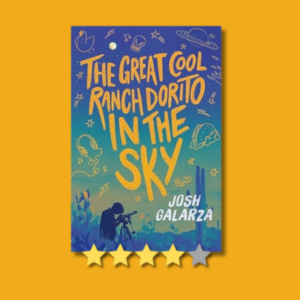
 Published: 2024
Author: Josh Galarza
Genres: YA Realistic Fiction, Mental Health, Graphic Narrative Elements
Audience: Grades 9–12
Number of Stars: ★★★★☆ (4/5)
Goodreads Link: The Great Cool Ranch Dorito in the Sky
Content Warnings: Bulimia nervosa, “food addiction” themes, grief (death of a parent), suicide, and cyberbullying.
Publisher’s Summary
Perfect for fans of Mark Oshiro and Adam Silvera comes a fiercely funny and hopeful story of one boy’s attempts to keep everything under control while life has other plans.
Ever since cancer invaded his adoptive mother’s life, Brett feels like he’s losing everything, most of all control. To cope, Brett fuels all of his anxieties into epic fantasies, including his intergalactic Kid Condor comic book series, which features food constellations and characters not unlike those in his own life.
But lately Brett’s grip on reality has started to lose its hold. The fictions he’s been telling himself – about his unattractive body, the feeling that he’s a burden to his best friend, that he’s too messed up to be loved – have consumed him completely, and Brett will do anything to forget about the cosmic-sized hole in his chest, even if it’s unhealthy.
But when Brett’s journal and deepest insecurities are posted online for the whole school to see, Brett realizes he can no longer avoid the painful truths of his real-life narrative. As his eating disorder escalates, Brett must be honest with the people closest to him, including his new and fierce friend Mallory who seems to know more about Brett’s issues than he does. With their support, he just might find the courage to face the toughest reality of all.
Full Review
The Great Cool Ranch Dorito in the Sky is a poignant and age-accessible exploration of how grief can destabilize a young person’s sense of self. Brett is a relatable protagonist, especially for anyone who has ever used creative outlets—like his Captain Condor comics—to escape a painful reality. Josh Galarza does an excellent job of addressing the specific ways grief impacts adolescents who are already navigating massive life changes and social pressures.
For Brett, grief fuels a disordered relationship with food. The novel handles the complexities of bulimia nervosa and the controversial concept of “food addiction” with sensitivity, eventually showing Brett naming his struggle and entering treatment. I particularly appreciated the intersectional look at identity; the book explores the unique “gaps” in history and self-worth that can affect adoptees, especially those adopted outside of their own culture.
While the subject matter is heavy, the connection between Brett’s recovery and his journey toward self-acceptance is beautifully woven. It serves as an excellent “mirror” for students who feel the intense pressure of self-consciousness regarding their appearance. It’s a story about the bravery it takes to stop hiding behind a fantasy and start living in the truth.
🎨 Comics as a Coping Mechanism
Brett uses his “Kid Condor” comics to process emotions that are too big for his real life. This is a common psychological tool known as Creative Externalization.
The Symbolism of the Dorito
- The Constellation: For Brett, the “Great Cool Ranch Dorito” is a source of strength for his hero, Captain Condor.
- The Reality: It represents his fixation on food and his desire to find order and meaning in a chaotic universe following his mother’s death.
- The Shift: Recovery involves Brett moving from seeing the “Dorito” as a magical source of power to understanding his own internal strength.
🥗 Understanding Bulimia and Binge Eating
The novel tackles the difficult debate regarding “food addiction”—specifically the struggle of being addicted to a basic necessity.
Identity and the Adoptee Experience
Brett’s struggles are compounded by his identity as an adoptee. The novel touches on:
- Cultural Displacement: The feeling of being “outside” one’s culture of origin.
- The Burden of Gratitude: The pressure some adoptees feel to be “perfect” to justify their place in a family.
- Gaps in History: How a lack of biological medical or social history can make a person feel like a “blank page.”
🎒 Classroom & Curricular Connections
-
Health & Wellness (Eating Disorders in Males): Eating disorders are often stereotyped as “female” issues.
Activity Idea: Discuss how Brett’s experience challenges these stereotypes. How do social media and “gym culture” impact male body image specifically?
-
Art & ELA (Graphic Storytelling): Analyze how Brett’s comics mirror his real-life trauma.
Activity Idea: Have students create a single-page comic featuring a “Superhero” that represents a strength they have, and a “Villian” that represents a hurdle they are currently facing.
-
Social Studies (The Sociology of Adoption): Explore the “Transracial Adoption” experience.
Activity Idea: Research the importance of cultural preservation in adoption. Why does Brett feel a “cosmic-sized hole” that isn’t just about his mother’s death, but also about his history?
-
Media Literacy (The Impact of Cyberbullying): Brett’s journal is posted online.
Activity Idea: Discuss the “Digital Footprint” and the ethics of online privacy. What are the legal and social consequences of “doxing” or sharing someone’s private thoughts without consent?