 Published: 2024
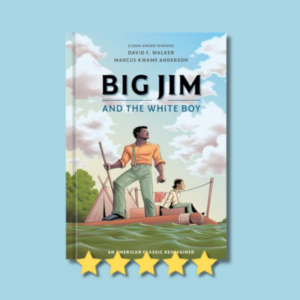
Author: David F. Walker
Illustrator: Marcus Kwame Anderson | Colorist: Isabell Strubel
Genres: YA Graphic Novel, Historical Fiction, Reimagined Classics
Audience: Grades 9–12, Adult
Number of Stars: ★★★★★ (5/5)
Goodreads Link: Big Jim and the White Boy
Content Warnings: Graphic violence, heavy usage of racial slurs (contextualized in the author’s note), and depictions of systemic racism.
Publisher’s Summary
A thrilling graphic novel re-imagining of The Adventures of Huckleberry Finn that follows Jim, an enslaved man on a journey towards freedom, and his sidekick, Huck, in the antebellum South
Commonly regarded as one of the great American novels, The Adventures of Huckleberry Finn has captured the hearts and imaginations of readers since 1885. But since its publication critics have rightfully condemned Mark Twain’s troubling portrayal of Black Americans as stereotypes and caricatures, with contemporary fans searching for a modern update to this iconic tale.
Big Jim and the White Boy is a radical retelling of this American classic, centering the experiences of Jim, an enslaved Black man in search of his kidnapped wife and children, along with his cheeky sidekick, Huckleberry Finn. Jim and Huck’s high-stakes adventures take them on an epic voyage across the antebellum South and Midwest, through Confederate war camps and runaway safe houses, into Old West standoffs, and on the road as covert Underground Railroad agents. Intertwined with the story of Jim and Huck are the stories of Jim’s descendants in the 1930s, 1980s, and 2020s, making this a multi-generational family epic as well as an adventure story.
Review
Big Jim and the White Boy is a graphic novel retelling of Huckleberry Finn by Mark Twain. The novel shifts between the time of the original novel, Jim and Huck as old men telling the story to Jim’s family to set the record straight, one of Jim’s descendants who was there for the retelling passing the story on to her granddaughter in the 1980s, and then the granddaughter lecturing about the truth of Jim and Huckleberry as a professor in the present day.
The plot of Big Jim and the White Boy is infinitely more compelling than its source material, largely because Jim is an actual, fleshed-out character and also because the novel doesn’t skirt around how dangerous the reality of Jim and Huck’s world would have been in a way the original novel sometimes does. This fullness and grittiness, paired with the movement between time periods, makes the novel a moving and fast read. I particularly enjoyed the scenes of Jim and Huck as old men telling the story because the depiction of Jim having lived well beyond the end of the events of Huckleberry Finn does a wonderful job of making Jim a fully developed character, but also helps to drive home for the reader that we really aren’t that far removed from the era of Huckleberry Finn.
Readers of the novel should note that there are some depictions of violence and also heavy usage of racial slurs. The author does include a lengthy author’s note at the start of the novel explaining their reasoning for including this language in the text. It is a reflection of the time and the original novel Big Jim and the White Boy is responding to, and that to censor this would be to ignore the reality and legacy of institutionalized racism in this country.
🎒 Classroom & Curricular Connections
- ELA (Comparative Literature): Pair this with Twain’s Huckleberry Finn to discuss the concept of “The Other.”
- Activity Idea: Identify a specific scene from the original book and find its reimagined counterpart in the graphic novel. How does changing the narrator from Huck to Jim change the meaning of the scene?
- History (The Underground Railroad): Explore the reality of “runaway safe houses” and “Confederate camps.”
- Activity Idea: Research the Fugitive Slave Act of 1850. How did this law make Jim and Huck’s journey even more dangerous than depicted in the 1885 original?
- Social Studies (Oral Traditions & Genealogy): Discuss how Jim’s story survived through his descendants.
- Activity Idea: Interview a family member about a story that has been “passed down.” Why do oral histories sometimes differ from “official” history books?
- Media Literacy (Censorship & Language): Analyze the author’s note regarding racial slurs.
- Activity Idea: Discuss the difference between using a slur for shock value versus retaining it for historical accuracy and social commentary. Why did Walker feel it was necessary to keep the language of the original text?