 Review by: Heather Turner
Published: 2023
Author: Steve Sheinkin | Illustrator: Nick Bertozzi
Genres: Nonfiction Graphic Novel, WWII History, Espionage
Audience: Grades 4–12 (Middle & High School)
Number of Stars: ★★★★★ (5/5)
Goodreads Link: Bomb (Graphic Novel)
Content Warnings: Graphic descriptions of war-related injuries and deaths, and mentions of suicidal ideation.
Publisher’s Summary
A riveting graphic novel adaptation of the award-winning nonfiction book, Bomb —the fascinating and frightening true story of the creation behind the most destructive force that birthed the arms race and the Cold War. In December of 1938, a chemist in a German laboratory made a shocking discovery: When placed next to radioactive material, a Uranium atom split in two. That simple discovery launched a scientific race that spanned three continents.
In Great Britain and the United States, Soviet spies worked their way into the scientific community; in Norway, a commando force slipped behind enemy lines to attack German heavy-water manufacturing; and deep in the desert, one brilliant group of scientists was hidden away at a remote site at Los Alamos. This is the story of the plotting, the risk-taking, the deceit, and genius that created the world’s most formidable weapon. This is the story of the atomic bomb.
New York Times bestselling author Steve Sheinkin’s award-winning nonfiction book is now available reimagined in the graphic novel format. Full color illustrations from Nick Bertozzi are detailed and enriched with the nonfiction expertise Nick brings to the story as a beloved artist, comic book writer, and commercial illustrator who has written a couple of his own historical graphic novels, including Shackleton and Lewis & Clark. Accessible, gripping, and educational, this new edition of Bomb is perfect for young readers and adults alike.
Review
Steve Sheinkin’s graphic novel offers a fascinating and eye-opening look at World War II, particularly the lesser-known efforts surrounding the development of the atomic bomb. The book highlights the critical role of Norwegian commandos, whose sabotage efforts significantly impeded Germany’s ability to develop nuclear weapons. Through a compelling narrative centered on espionage, especially the story of a spy whose capture helps drive the plot, Sheinkin brings a complex and often overlooked part of history to life.
One of the most striking aspects of this book is how much new information it presents, even for readers familiar with WWII. Even those who have seen Oppenheimer will learn details not covered in the film. Insights such as President Truman’s initial lack of knowledge about the Manhattan Project, along with his earlier attempts to uncover where government funds were being allocated, add depth and surprise. Additionally, the suggestion that a mistranslation may have influenced the decision to drop the second atomic bomb on Japan introduces readers to the uncertainty and nuance behind major historical events.
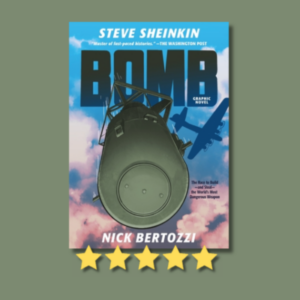
The illustrations are appropriately dark in tone, reinforcing the gravity of the subject matter. The use of speech bubbles is clear and accessible, making this an excellent entry point for readers who may be new to graphic novels. Students will likely be drawn in by the format and engaging cover, while educators will appreciate its strong curricular connections to World War II, government decision-making, and ethical dilemmas in history.
Themes of moral ambiguity, loyalty, and the consequences of scientific advancement are woven throughout. Sheinkin does not present history as black and white, but instead emphasizes the gray areas, encouraging critical thinking. This book would pair well with classroom discussions, debates, or research projects on wartime ethics and espionage.
I would highly recommend this title for middle and high school students, particularly in social studies classrooms. It is both engaging and informative, and serves as an excellent resource for helping students understand the complexities and moral gray areas of history.
⚛️ The Science and Sabotage of the Manhattan Project
The “Race to the Bomb” was not just a scientific challenge, but a global game of chess involving multiple fronts.
Key Historical Interventions
| The Mission | Location | Significance |
| Project Alberta | Los Alamos, NM | The central hub where Oppenheimer’s team designed the actual weapons. |
| Operation Gunnerside | Vemork, Norway | Norwegian commandos sabotaged the “Heavy Water” plant, stalling the Nazi nuclear program. |
| Soviet Espionage | Various US Sites | Spies like Klaus Fuchs smuggled technical secrets back to the USSR, accelerating their program. |
🎒 Classroom & Curricular Connections
- Social Studies (WWII & The Cold War): Use the book to discuss the transition from hot war to nuclear standoff.
- Activity Idea: Research the “Vemork Sabotage.” Why was “Heavy Water” so essential to the German nuclear program?
- Government (Presidential Power): Discuss the reviewer’s note about Truman’s lack of knowledge regarding the project.
- Activity Idea: Discuss the “need to know” basis of top-secret government funding. How much should a Vice President know before taking office?
- Science & Ethics (The Responsibility of Discovery):
- Activity Idea: Debate the “gray areas” of scientific advancement. Once a discovery like fission is made, do the scientists have a responsibility for how it is used?
- Media Literacy (Graphic Narratives): Analyze how Nick Bertozzi uses color and framing to convey tension.
- Activity Idea: Find a page with no dialogue. How do the illustrations tell the story of a “silent” commando mission or a “secret” lab?