 Review By: Anonymous
Published: 2023
Genres: Adult Fiction, African Literature, Contemporary
Audience: Grades 11–12, Adult
Number of Stars: ★★★★☆ (4/5)
Goodreads Link: Daughter in Exile
Content Warnings: Violence, trauma, racism, pregnancy/childbirth, death, suicide, profanity, and sexual encounters.
Publisher’s Summary
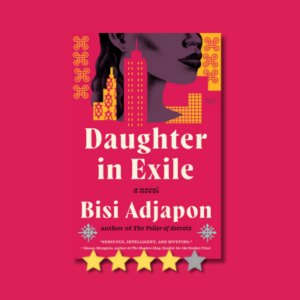
Lola is twenty-one, and her life in Senegal couldn’t be better. An aspiring writer and university graduate, she has a great job and a vibrant social life. But fate disrupts her world when she falls for Armand, an American Marine stationed at the U.S. Embassy. Despite her mother’s disapproval, Lola boards a plane for Armand and America, only to find herself in the perilous position of an undocumented immigrant in 1990s America.
Traded for her carefree existence in Senegal, Lola encounters adversity that would crush a less-determined woman. Her fate hangs on whether or not she’ll grow in courage to forge a different life from the one she imagined, and whether she’ll succeed in putting her family back together. Daughter in Exile is a hope-filled story about mother-love, resilience, and unyielding strength.
Review
An inspirational story about the determination of an immigrant woman trying to build a life for herself and her children, while honoring her family in Ghana, despite having the odds stacked against her. Her perseverance is inspirational as she maneuvers around each roadblock she encounters on her journey.
“Daughter in Exile” follows the story of Lola, a Ghanaian woman, working in Senegal who falls in love with a Haitian-American soldier, Armand. She becomes pregnant, he leaves to be stationed in the Bahamas and Lola moves to America thinking she will build a life with him and live the “American dream”. From the moment she steps off the plane in the U.S., it is one difficulty after another only to be blindsided when Armand breaks up with her over the phone. Lola has difficulty finding employment because she does not have her papers to work but she did find some good friends along her journey. Somehow, she manages to survive. She ends up attending a Christian church where she experiences racism and the hypocrisy of most religions. However, she does meet a very kind man who she ends up marrying and becoming pregnant. Unfortunately, he gets into some legal trouble and takes his life. She considers adoption for her daughter which was encouraged by the church. Lola continues to experience hardship when her in-laws try to take her baby from her. Lola ends up meeting a lawyer who helps her and she is ultimately granted citizenship by a judge. This book provokes a lot of thought about the experience of an immigrant, a woman of color raising two children by herself, the sanctimoniousness of organized religion, as well as the complexity of being torn between two cultures.
I would recommend this book for older students. It does have some profanity and sexual encounters in it that would not be appropriate for [younger] high school students. However, the themes addressed in this book are something that students could benefit from exploring. Those include: displacement, identity and belonging, sacrifice, immigration, racism, and religious hypocrisy. There are several activities that could be done with these themes. For example, given current situations immigration and what Lola went through trying to do things the legal way only to be taken advantage of several times is something students could explore. There are many comparisons and contrasts that could be made between this book and others with similar themes. It would also be interesting to compare the way of life, childbirth, child-rearing, the family dynamic and cultural differences in the United States versus Ghana. I think there are many ways teachers could use these things in classroom projects/activities.
📊 Ghanaian Immigration & The Diaspora
To provide context for Lola’s journey, it is helpful to look at the statistical landscape of West African immigration to the United States:
- Growth of the Diaspora: The Ghanaian immigrant population in the U.S. has seen significant growth, rising from approximately 65,000 in 2000 to over 235,000 by 2019.
- Education Levels: Ghanaian immigrants often arrive with high levels of formal education; roughly 42% of Ghanaian-born adults in the U.S. hold a bachelor’s degree or higher, compared to about 33% of the total U.S. population.
- The Undocumented Experience: In the late 1990s (the book’s setting), African immigrants represented a small but growing segment of the undocumented population. Recent data suggests that approximately 14% of all African immigrants in the U.S. are undocumented, facing the specific legal and employment roadblocks Lola encounters in the novel.