 Published: 2024
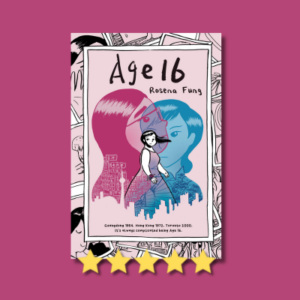
Author/Illustrator: Rosena Fung
Genres: YA Graphic Novel, Historical Fiction, Contemporary
Audience: Grades 7–12, Adult
Number of Stars: ★★★★★ (5/5)
Goodreads Link: Age 16
Content Warnings: Disordered eating, body image issues, diet culture, domestic violence, homophobia, and mild language.
Publisher’s Summary
Sixteen-year-old Roz is navigating the typical pressures of high school in Toronto: friendships, college stress, and prom. But when her estranged Por Por (grandmother) arrives for an indefinite visit, the delicate balance between Roz and her mother, Lydia, is upended. With three generations under one roof, long-suppressed family secrets begin to surface.
Told in alternating perspectives, Age 16 shifts seamlessly between time and place—Guangdong in 1954, Hong Kong in 1972, and Toronto in 2000—exploring how this pivotal year in adolescence affects three women in the same family. Award-winning creator Rosena Fung pulls from her own family history to craft a poignant story about generational trauma and the resilience required to break the cycle.
Full Review
This deeply personal graphic novel tells the story of three 16-year-old girls who make up three generations of a family at different times: Mei Laan in China in 1954, her daughter Lydia in Hong Kong in 1972, and Lydia’s daughter Rosalind in Toronto in 2000. Although they are fictional, the author draws heavily on her own family history to explore generational trauma.
Despite being separated by decades and miles, each girl faces universal challenges with sexism, body image, and societal expectations. We see how the hardship Mei Laan endured during the Sino-Japanese War impacts her harsh treatment of Lydia. In turn, adult Lydia wants to protect Rosalind from the same body criticism she experienced, but inadvertently repeats the behavior.
Fung’s artistic choices are brilliant. She differentiates each timeline with distinct color palettes and era-specific details like butterfly clips and boy band posters. Most strikingly, she anthropomorphizes objects to illustrate their psychological effect—such as a bathroom scale taunting Rosalind. This is a heartbreaking, relatable, and deeply human story that will make readers reflect on their own family relationships.
📊 Statistics: Body Image & Disordered Eating
Rosalind’s struggle reflects significant real-world data regarding adolescent mental health and body image.
- Prevalence: Research indicates that approximately 50% of teenage girls and 30% of teenage boys use unhealthy weight control behaviors (such as skipping meals, fasting, or smoking).
- Cultural Factors: Studies show that second-generation immigrants often experience higher rates of body dissatisfaction due to the “acculturation” process—the pressure to balance the beauty standards of their heritage culture with those of their new home.
- Impact of Family: Research suggests that a mother’s dissatisfaction with her own body is one of the strongest predictors of her daughter’s development of disordered eating.
🎒 Classroom & Curricular Connections
- 7th Grade ELA (Character Study): Analyze how the “Setting” influences a character’s “Conflict.” How does being 16 in 1954 China differ from being 16 in 2000 Canada?
- Health & Wellness (Body Image): Use the scenes with the “talking scale” to discuss the internal critic. How does “diet culture” manifest in different eras?
- Social Studies (The Immigrant Experience): Discuss the concept of Diaspora. How do the characters preserve their Chinese heritage while adapting to life in Hong Kong or Toronto?
- Visual Literacy (Graphic Novel Techniques): Have students identify the different color palettes used for each generation. Why did the artist choose specific colors for 1954 versus 2000?