 Published: 2021 (English Translation)
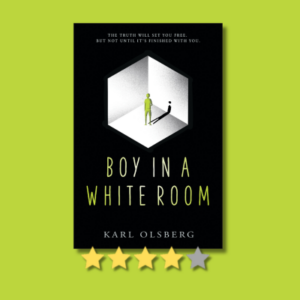
Author: Karl Olsberg
Genres: YA Sci-Fi, Dystopian, Thriller, Suspense
Audience: Grades 8–10
Number of Stars: ★★★★☆ (4/5)
Goodreads Link: Boy in a White Room
Content Warnings: Kidnapping, murder, and violence.
Publisher’s Summary
A fifteen-year-old boy wakes up in a white, cube-shaped room. No windows. No doors. Total silence. He has no memories of who he is or how he got there. His only companion is a computer-generated voice named Alice. Through her, he accesses the internet and a live feed of strangers’ lives called Eyestream.
As he uncovers fragments of a possible past—an attempted abduction, a critical injury, a murder—the boy begins to piece together a story. But as the snippets of information refuse to fit together perfectly, the lines between reality and virtual illusion blur. In a world where technology can simulate anything, he must find the answer to the most terrifying question of all: Who am I really?
Full Review
Boy in a White Room is a mind-bending sci-fi thriller that feels like an episode of Black Mirror written for a YA audience. The premise is immediately gripping: a boy with no physical sensations trapped in a void, relying entirely on an AI to understand his existence. Karl Olsberg explores the frightening potential of technology and how it often advances faster than our moral or psychological preparedness.
I particularly enjoyed the high-concept questions the book raises about virtual reality versus real life. For students interested in programming, streaming, or the ethics of AI, this will be a fascinating read. While there are a few plot holes that might cause minor confusion, and the heavy references to The Lord of the Rings and Alice in Wonderland might be lost on some readers, the overall suspense kept me guessing until the very end. It is a thought-provoking look at a future where the truth is the most difficult thing to find.
💻 Virtual Reality and the Brain
The novel explores the “Turing Test” for reality: If a simulation feels exactly like real life, is there a difference? It delves into how our brains process sensory input and how that can be manipulated by technology.
🎒 Classroom & Curricular Connections
-
Computer Science & Ethics: Discuss the concept of Artificial Intelligence.
Activity Idea: Research the Turing Test. At what point does an AI like “Alice” cross the line from a program to a sentient being?
-
ELA (Literary Allusions): The book references Alice in Wonderland and The Lord of the Rings.
Activity Idea: Discuss the “Rabbit Hole” metaphor. How does Manuel’s journey into his own data mirror Alice’s journey into Wonderland?
-
Philosophy (Epistemology): Explore the “Simulation Hypothesis.”
Activity Idea: Read excerpts from Plato’s “Allegory of the Cave.” How is Manuel’s white room a modern, high-tech version of the cave dwellers seeing only shadows of reality?
-
Media Literacy (Streaming Culture): Analyze the “Eyestream” concept.
Activity Idea: Discuss the ethics of “vlogging” and “live-streaming.” If a person’s entire life is broadcast, does that life become a performance?
-
Science (Neurobiology): Manuel mentions he “cannot feel.”
Activity Idea: Study how the nervous system sends signals to the brain. If those signals are intercepted by a computer, can the brain be tricked into feeling a “virtual” body?