 Published: 2025
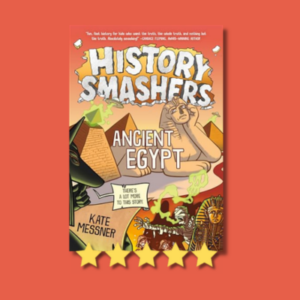
Author: Kate Messner | Illustrator: Falynn Koch
Genres: Nonfiction, History, Graphic Novel Hybrid
Audience: Grades 5–8
Number of Stars: ★★★★★ (5/5)
Goodreads Link: History Smashers: Ancient Egypt
Publisher’s Summary
Myths! Lies! Secret mummy curses? Grab your head lamp, the award-winning History Smashers are headed to Ancient Egypt to dig up the truth about this incredible early civilization—and the many myths that will be buried once and for all.
In 1922, explorers opened King Tut’s tomb and a nasty hex was placed on everyone present. RIGHT? Not so much. Okay, but aliens did soar in on a space craft and build the Pyramids, right? WRONG!
The discovery of King Tutankhamun’s tomb taught historians a lot about ancient Egyptian culture. But no one incurred the wrath of a mummy. And this early civilization had the money, power, and smarts to build the Pyramids–along with a host of other impressive structures!
Join the History Smashers team to bust history’s biggest misconceptions around the ancient Egyptians and decipher the truth behind this innovative civilization that spanned thousands of years!
Full Review
Kate Messner’s “History Smashers” series titles are always engaging, and this book is no exception. I think that middle school students, as well as upper elementary students, will love this book. Ancient Egypt is a popular topic among students, and this nonfiction book shares the information about this topic in a very entertaining manner. The book includes regular chapters, black and white comic-style panels, photos and drawings, and the writing is full of facts and humor.
I found lots of interesting and surprising details as I read through this graphic novel. Topics include pyramid design and the architects behind their construction, the impact of the Nile River’s flood season, and information about the Great Sphinx (I didn’t realize that it was built to guard the tombs of Egyptian royalty). Additionally, the book provides further information about the history of hieroglyphs, and the role of the Rosetta Stone in learning how to decode them.
Messner also debunks several myths about Ancient Egypt and provides insight into the rule of royal succession. Theories about Queen Nefertiti are also explored: for example, some archeologists believe that she was a female pharaoh who ruled under the name Neferneferuaten. It’s possible that her tomb is buried near King Tut’s tomb, but at the moment, further excavation is not allowed by the Egyptian government. As an elementary school student, I was very fascinated by Ancient Egypt and I would have loved this book had it been published several decades ago. This would be a worthwhile purchase for both elementary and middle school libraries.
🔍 Debunking the Myths
The History Smashers series is famous for taking popular legends and applying scientific and historical scrutiny to them.
- The Curse of the Pharaohs: While the media sensation in 1922 suggested a “mummy’s curse” fell on those who opened King Tut’s tomb, historical records show that the people present actually lived long lives. The “curse” was a fabrication to sell newspapers.
- Alien Architects: The notion that aliens built the pyramids ignores the advanced mathematical, engineering, and organizational capabilities of the Egyptians, who utilized thousands of skilled laborers, complex leverage systems, and the seasonal flooding of the Nile for transport.
- The Sphinx’s Purpose: Often thought of as a mysterious deity, the Great Sphinx was designed as a guardian figure to protect the royal tomb complexes.
🏛️ Key Historical Concepts
- The Nile River: The lifeblood of the civilization. Its annual flood cycles allowed for predictable agriculture in an otherwise desert environment.
- Hieroglyphs & The Rosetta Stone: Hieroglyphs were a complex system of writing. The discovery of the Rosetta Stone—which featured the same text in three different scripts—was the “key” that allowed modern scholars to finally decipher them.
- Royal Succession: The book provides a great breakdown of how power was passed down, including the fascinating case of female pharaohs like Nefertiti (Neferneferuaten).
🎒 Classroom & Curricular Connections
- History (Civilization & Engineering): Discuss how geography shapes the development of a culture.
- Activity Idea: Map the Nile River. Why was it essential to the location of the pyramids?
- ELA (Media Literacy & Myth Busting): Analyze why myths persist even when facts are available.
- Activity Idea: Pick a modern “myth” and have students create a “Smasher” page in the style of the book, presenting evidence to debunk it.
- Art/Writing (Hieroglyphs): Explore how visual art functions as language.
- Activity Idea: Have students write their own names using a guide to hieroglyphic symbols.
- Research Skills (Archeology): Discuss the ethics of excavating tombs.
- Activity Idea: Research why the Egyptian government currently limits excavation around King Tut’s tomb. What are the pros and cons of archaeology?