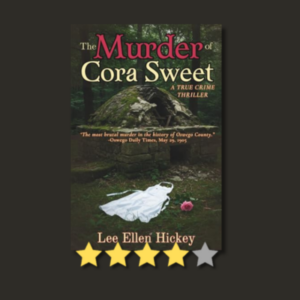
 Published: 2025
Author: Lee Ellen Hickey
Genre: Narrative Nonfiction / True Crime / Local History
Audience: Adults, Older High School Students (11–12)
Number of Stars: ★★★★☆ (4/5)
Goodreads Link: The Murder of Cora Sweet
Content Warnings: Physical and sexual abuse, the murder of a child, alcoholism, and mental illness. Recommended for mature readers only.
Publisher’s Summary
Set in the rural community of Scriba, NY, in 1905, this narrative nonfiction thriller explores the chilling details of a murder that shattered a family and shook an entire community to its core. Based on extensive research of period newspaper articles and court records, the book examines the life of Henry Manzer, the man convicted of the crime, and the tragic circumstances that led to the death of young Cora Sweet. It is a haunting exploration of how a childhood marred by cruelty can manifest into devastating violence.
Review
“The Murder of Cora Sweet” by local author Lee Ellen Hickey is a true-crime novel that depicts the killing of a young girl in Scriba, NY, in 1905. The book is a blend of fact and narrative storytelling, and it draws extensively on historical newspaper articles and court records. Henry Manzer was found to be the perpetrator of the murder, and the book is divided into two sections: “Henry” and “Manzer.”
Part one, “Henry,” explores the murderer’s troubled background as a young child. Henry endured multiple abuses and grew up in poverty, which were contributing factors to his mental illness and violent behavior. The book provides an interesting and emotional glimpse into the psychology behind the crime. Part two, “Manzer,” depicts the adult life of Henry Manzer and the monster that he became.
Hickey is also the author of “The Girl in the Glass Coffin,” which is another local historical tale. Interestingly, the events in that book receive mention in this second novel, as there are connections between the people and events in both books. Hickey paints an authentic picture of the community outrage that surrounded this horrible event: one that was labeled as “the most brutal crime ever committed in Oswego County” by the 1905 Syracuse Journal.
There are many potentially sensitive topics that are covered in this novel. For this reason, I would only recommend this book for older high school students as well as adults. It’s a compelling read, especially for those interested in the history of upstate New York.
🏛️ Historical Context: True Crime Research
Narrative nonfiction like this relies on the careful synthesis of primary and secondary sources. To understand the gravity of the 1905 investigation, readers must look at the era’s legal and social landscape.
- Primary Sources: The author utilized original court records and contemporary newspaper reports (such as the Syracuse Journal) to reconstruct the timeline of the crime and the resulting trial.
- Psychological Profiling in History: By dividing the book into “Henry” (the child/victim of abuse) and “Manzer” (the perpetrator), the author attempts to trace the developmental path from trauma to criminal violence.
🎒 Classroom & Community Connections
- Local History (Upstate New York): This work contributes to the preservation of regional history by documenting events that were once headline news in Oswego County.
- Activity Idea: Compare and contrast the 1905 reporting style of the Syracuse Journal with modern true-crime journalism. How has the way we write about crime changed over the last 120 years?
- Criminal Justice (Nature vs. Nurture): The book serves as a case study for the “nature vs. nurture” debate.
- Activity Idea: Research the state of mental health resources in early 20th-century rural New York. How did the lack of social safety nets contribute to cycles of abuse and poverty in this era?
- Ethics of True Crime: Discuss the ethical responsibility of an author when writing about real victims and historical tragedies.
- Activity Idea: Why is it important to tell the stories of victims like Cora Sweet? How do we balance the “thriller” aspect of the genre with the need to honor the dignity of the deceased?