 Published: 2020
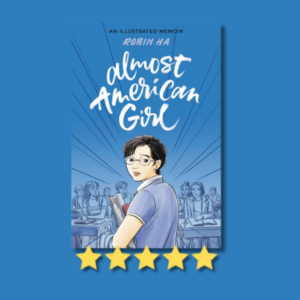
Author/Illustrator: Robin Ha
Genre: YA Graphic Memoir / Nonfiction
Audience: Grades 9–12, Adult
Number of Stars: ★★★★★ (5/5)
Goodreads Link: Almost American Girl
Publisher’s Summary
Growing up in the 1990s as the only child of a single mother in Seoul, Korea, wasn’t always easy, but it bonded Robin and her mom fiercely together. So when a “vacation” to Huntsville, Alabama, unexpectedly becomes a permanent relocation—following her mother’s surprise marriage announcement—Robin is devastated.
Overnight, her life is upended. She is dropped into a school where she doesn’t speak the language, cut off from her friends, and struggling to navigate a new stepfamily that feels like a world apart. Furious with her mother and feeling like an outsider in both cultures, Robin feels lost—until her mother enrolls her in a local comic drawing class. This simple act opens a window to a future Robin never imagined and provides the bridge she needs to find her voice in a new country.
Review
I liked this book! It proved to hold my interest and felt truly authentic. Personally, I haven’t read much literature written by a Korean writer, so this book was refreshing. I specifically liked the incorporation of the Korean language into the story; while I couldn’t understand it as I read, the glossary at the back of the book was a helpful tool.
The story takes the reader through multiple schools and the specific trials each environment presented for the author. I chose this book because I am looking for new material to add to my curriculum, and a multicultural graphic novel is a perfect combination. I feel like this book is highly appropriate for the high school level because there is significant depth to it—the story takes time to digest and analyze what is happening and why. It’s a great book!
🎨 The Visual Language of Comics
For Robin Ha, comics weren’t just a hobby; they were her primary way of communicating when her verbal language failed her.
- Language Barriers in Art: Ha uses the graphic novel format to show her frustration. In some panels, English speakers’ words appear as illegible scribbles or symbols to the reader, mirroring exactly how Robin felt in her Alabama classroom.
- Cultural Juxtaposition: The art style shifts slightly when reflecting on her life in Seoul versus her new life in Huntsville, highlighting the stark difference in her environment and emotional state.
- Drawing as a Bridge: The book illustrates how the “visual language” of art is universal. Even before she mastered English, Robin could connect with others through her drawings.
🎒 Classroom & Curricular Connections
- Social Studies (The Immigrant Experience):
- Activity Idea: Discuss the concept of “The American Dream” from a 1990s perspective. Compare Robin’s experience in Huntsville, Alabama, to typical immigrant narratives set in major hubs like NYC or LA. How did the location impact her isolation?
- ELA (Memoir & Theme):
- Activity Idea: Analyze the theme of “Betrayal vs. Sacrifice.” Robin is initially furious with her mother for moving them. Have students write an essay or hold a discussion on the mother’s perspective—was the move an act of love or an act of selfishness?
- Visual Arts (Graphic Storytelling):
- Activity Idea: Have students create a single-page comic about a time they felt like an “outsider.” Encourage them to use visual cues (like the scribbled speech bubbles mentioned above) to represent a lack of understanding or connection.
- World Languages/Culture:
- Activity Idea: Use the book’s glossary to learn basic Korean phrases. Discuss the role of “Hangul” (the Korean alphabet) and how seeing a different script in a familiar format (a comic) helps build empathy for English Language Learners (ELL).