 Published: 2025
Author: Katherine Applegate | Illustrator: Charles Santoso
Genre: Middle Grade / Fantasy / Historical Fiction
Audience: Grades 4–8
Number of Stars: ★★★★★ (5/5)
Goodreads Link: Pocket Bear
Publisher’s Summary
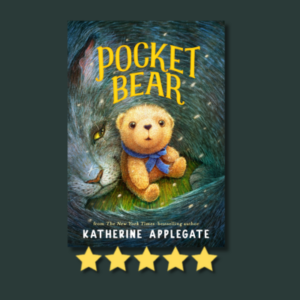
Thimble-born from tip to toe, Pocket Bear remembers every moment of his “becoming”: the glimmering needle, the silken thread, the tender hands as each careful stitch brought him closer to himself. Born during the throes of WWI, he was designed to fit into the pocket of a soldier’s jacket, eyes sewn a bit higher than normal so that he always gazed upward. That way, glancing at his pocket, a soldier would see an endearing token of love from someone back home, and, hopefully, a good luck charm.
Now, over a century later, Pocket serves as unofficial mayor of Second Chances Home for the Tossed and Treasured, where stuffed toy animals are refurbished and given a fresh opportunity to be loved. He and his best feline friend Zephyrina, known far and wide as “The Cat Burglar,” have seen it all, and then some.
An unforgettable tale of bravery, loyalty, and kindness, Pocket Bearreminds us all that love comes in many forms (sometimes filled with fluff), and that second chances are always possible.
Review
Katherine Applegate’s Pocket Bear is a story about courage, kindness, and second chances. Pocket was handmade during World War I and is small enough to fit inside a pocket. These bears were actually given to soldiers during the war for good luck and to help them remember home. It has been several decades since Pocket was made; during that time, he survived the war and the pain of loss.
Eventually, he finds himself at a second-hand store where abandoned stuffed animals are repaired. During his time at the store, he befriends a cat named Zephyrina. Zephyrina belongs to Dasha, a young Ukrainian refugee. Together, they help to repair discarded toys and help them find new homes. But it’s the act of kindness that Zephyrina performs for Pocket that truly makes the story.
Written in classic Katherine Applegate style, Pocket Bear does not disappoint. This is a heartfelt story of friendship, bravery, and loyalty. It brings a bit of history to current events and emphasizes that second chances are truly possible.
🛡️ History in a Pocket: WWI Mascot Bears
Pocket’s origin is rooted in a very real historical tradition from the Great War.
- The Trench Mascot: During WWI, soldiers often carried small charms or “pocket bears” to cope with the isolation and trauma of the trenches. These were often handmade by loved ones or charities (like the “Minnie” bears).
- The “Upward Gaze”: As mentioned in the book, many of these charms were sewn with eyes positioned high on the head. This allowed a soldier to look down at his breast pocket and see the bear “looking back” at him for comfort.
- Modern Connections: By placing the story in a shop owned by a Ukrainian refugee (Dasha), Applegate connects the historical trauma of WWI with modern-day displacement, showing that the need for comfort and “second chances” is universal across time.
🎒 Classroom & Curricular Connections
- Social Studies (WWI History & Global Conflict):
- Activity Idea: Research “Soldier Mascots” of WWI. Why were small tokens like Pocket Bear so important to soldiers’ morale? Discuss the role of “comfort objects” in historical and modern conflicts (linking to Dasha’s story).
- ELA (Personification & Perspective):
- Activity Idea: Pocket Bear remembers his “becoming” (the stitches and thread). Have students write a short narrative from the perspective of their own favorite childhood toy or a found object. What do they remember about their “becoming”?
- Creative Arts (Toy Restoration):
- Activity Idea: Discuss the concept of the Second Chances Home for the Tossed and Treasured. Have students bring in a “discarded” item (with permission) or find a picture of one, and write a “Refurbishing Plan”—what would it take to give this object a second chance?
- SEL (Empathy & Refugees):
- Activity Idea: Explore Dasha’s character. How does the act of repairing toys help her and her cat, Zephyrina, process their own experiences as refugees? Discuss how kindness to others (or to objects) can be a form of self-healing.