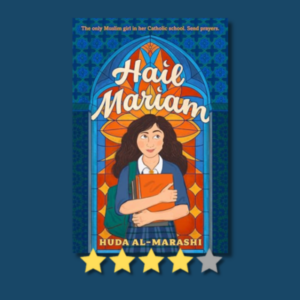
 Reviewer: Jenna Ballard
Published: 2026
Author: Huda Al-Marashi
Genre: Middle Grade Realistic Fiction
Audience: Grades 5–8
Number of Stars: ★★★★☆ (4/5)
Goodreads Link: Hail Mariam
Themes: Interfaith Dialogue, Identity, Family, Health Crisis, Coming-of-Age.
Publisher’s Summary
Hail Mariam is an interfaith Muslim take on Are You There God? It’s Me, Margaret drawn from the author’s own experiences in Catholic school.
Sixth grade wasn’t supposed to be this complicated.
Iraqi American Mariam Hassan transfers to a local Catholic school and before her first day her parents remind her that she might be the first Muslim her classmates have ever met. No big deal, right? Just represent an entire religion while making new friends, keeping up with schoolwork, and figuring out who she is.
When Mariam’s younger sister, Salma, is diagnosed with a serious lung condition, her family faces endless doctor visits and sleepless nights. Mariam tries to lighten their burden and keep her own problems to herself—including the fact that she’s just been cast as Mary in the school’s Christmas nativity play.
Mariam wants to honor her faith and her new community, but she’s terrified of crossing a religious line. Can a Muslim girl be the lead in a Christian story? What will her family think? And why does she feel like every decision she makes represents all Muslims?
Mariam discovers that faith, much like friendships, isn’t about perfection—it’s about connection. As she leans on her family, friends, and school community, she begins to see the power of interfaith cooperation and learns she doesn’t have to carry the weight of the world on her shoulders.
Hail Mariam is a celebration of the beauty of finding common ground.
Review
Promoted as an “interfaith Muslim take on Are You There God? It’s Me, Margaret,” this novel follows Mariam, a sixth-grader sent to Catholic school for a better education. While being raised Muslim by her Iraqi immigrant parents, Mariam must navigate the typical adolescent hurdles of jealousy, insecurity, and new friendships, all while being the only Muslim in her class.
The story shines when exploring Mariam’s internal conflict. She constantly worries about striking a balance: being respectful of Catholic traditions so her classmates don’t think Muslims are rude, while remaining a “good Muslim” according to her own faith. This tension peaks when she is cast as Mary in the Christmas play. She is thrilled to be chosen over her rival-turned-friend, Lauren, but panics that certain lines might clash with her beliefs.
It is rare to find a middle-grade novel so unabashedly about religion that doesn’t feel like it’s “promoting” one over the other. Instead, it highlights how much different faiths have in common. There is also a major storyline about Mariam getting her period during Mass—a scene that earns the Judy Blume comparisons for its authenticity and humor. The characters are likeable and the story is a sweet exploration of the idea that faith is rarely black and white.
🎒 Classroom & Curricular Connections
- Social Studies (Global Cultures & World Religions):
- Activity Idea: Use the book to discuss the concept of the “Model Minority” or “Ambassador” burden. Why does Mariam feel like her actions represent all Muslims? Discuss the importance of seeing individuals as individuals rather than symbols of a group.
- ELA (Comparative Literature):
- Activity Idea: Pair this with Judy Blume’s Are You There God? It’s Me, Margaret. Have students create a chart comparing how both protagonists talk to a “higher power” and how their questions about their bodies mirror their questions about their souls.
- Health & SEL (Empathy and Chronic Illness):
- Activity Idea: Mariam’s sister, Salma, has a serious lung condition. Discuss the “Sofa Effect”—how a sibling’s illness can make the healthy child feel like they have to be “perfect” to avoid adding more stress to the parents.
- Art & Drama (Symbolism):
- Activity Idea: Analyze the symbolism of the Nativity play. Have students design a “Cultural Bridge” poster that highlights common symbols of peace or family found in different religious traditions.