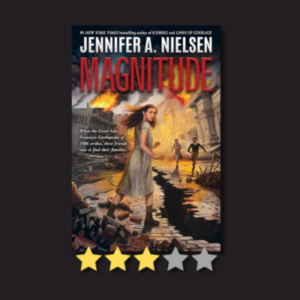
 Published: 2026
Author: Jennifer A. Nielsen
Genre: Middle Grade Historical Fiction / Survival
Audience: Grades 3–7+
Number of Stars: ★★★☆☆ (3/5)
Goodreads Link: Magnitude
Themes: Survival, Courage, Friendship, Natural Disasters, History.
Publisher’s Summary
San Francisco, 1906. When Cora leaves her house in the early morning hours of April 18th, she expects trouble to find her—but she doesn’t expect the earth to split open. As she makes her way to the docks to look for her father, a massive earthquake strikes, and Cora is buried as a building sways and collapses overhead.
Cora wakes up trapped underground with Zhi, a girl she met just before the quake. As they run out of air, Cora’s friend Oliver miraculously pulls them from the rubble. Above ground, the city is unrecognizable, decimated by the quake and plagued by raging fires. Together, the trio begins a desperate search for their families while trying to evade a gang of thieves pursuing Cora for a valuable secret she carries. From #1 New York Times bestselling author Jennifer A. Nielsen comes a thrilling story about the strength it takes to survive one of the most terrible natural disasters in American history.
Full Review
In Magnitude, written by Jennifer A. Nielsen delivers a gripping, heart-pounding survival story set during the Great San Francisco Earthquake 1906. The story centers on twelve-year-old Cora Henshaw. While navigating the docks early on April 18th to find her father, a massive quake decimated the city. After being trapped underground with a young girl named Chi, they are rescued by her friend Oliver. The trio journey through a devastated city that is now plagued with raging fires, aftershocks, and gangs of thieves. I would recommend this book for middle-graders especially if they are fans of the I Survived series by Lauren Tarshis. This book is much longer, 304 pages to 112 pages in the I Survived San Franscico Earthquake book. I think it is a sit on the edge of your seat adventure that older students will enjoy reading. This book could have curricular connections for Science and Geography, among a couple. Students could create structures using different materials (toothpicks, blocks, Legos, etc.) comparing them and create an earthquake by shaking the table that the structures are on to see which is more stable. Students could research how and why earthquakes happen or learn about the countries the tectonic plates are in.
If you enjoyed this book by Jennifer A. Neilson, then you might enjoy her, Ascendance Series, The Traitor’s Game Series, Mark of the Thief Series. Along with many standalone books that are historical fiction dealing with war, Nazis, the Titanic among others. There are some lessons that could be done with this book. One is to have the students, in English or Earth Science class, read information on earthquakes and then answer questions on what they read. Another Earth Science lesson would be for the students to create a newspaper front page describing the impact to the city and surrounding areas, how and why earthquakes happen, etc. For STEM class, students can create a structure that could withstand some shaking with whatever items are available (cardboard, marshmallows, toothpicks, etc.).
🌋 Earth Science: The Mechanics of 1906
The 1906 San Francisco earthquake was caused by a rupture on the San Andreas Fault. Understanding the “magnitude” of this event helps students appreciate the scale of Cora’s journey.
- Tectonic Shift: The earthquake was caused by a “slip” between the Pacific Plate and the North American Plate. This is known as a transform boundary, where plates slide past each other horizontally.
- Liquefaction: Much of the destruction in Cora’s San Francisco was due to “made land” (areas filled with soft soil and debris) turning to a liquid-like state during the shaking, causing buildings to sink or tilt.
- The Firestorm: While the quake was massive, nearly 90% of the city’s destruction actually came from the subsequent fires caused by ruptured gas lines and overturned stoves.
🎒 Classroom & Curricular Connections
- STEM / Engineering Challenge:
- Activity Idea: Provide students with toothpicks, marshmallows, blocks, or Legos. Challenge them to build a structure that can withstand a “table-quake.” Create a shake-table by placing a board on top of tennis balls or springs and observe which designs (e.g., those with cross-bracing) stay standing.
- Earth Science (Geology & Geography):
- Activity Idea: Research the San Andreas Fault and map out the countries or states that sit on major tectonic plate boundaries. Discuss why San Francisco is particularly vulnerable to these events.
- English Language Arts (Newspaper Project):
- Activity Idea: Create a “Front Page” for a 1906 newspaper. Students must write a lead article describing the impact on the city, an editorial on the “firestorm,” and a scientific sidebar explaining why the earthquake happened.
- Comparison & Analysis:
- Activity Idea: Compare Magnitude with a shorter text like I Survived the San Francisco Earthquake. Discuss how the increased length of Magnitude allows for more character development and “secret” subplots (like the one Cora is hiding).