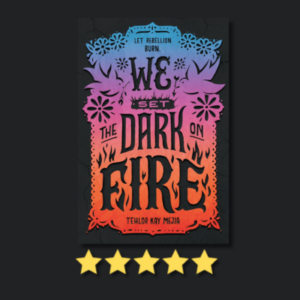
 Published: 2019
Author: Tehlor Kay Mejia
Genre: Young Adult Dystopian Fantasy / LGBTQ+ Romance / Political Thriller
Audience: Grades 7–10 (Middle School & Early High School)
Number of Stars: ★★★★★ (5/5)
Goodreads Link: We Set the Dark on Fire
Themes: Misogynistic Class Structures, Political Subversion, Forbidden Sapphic Romance, Systemic Inequality, Border Politics.
Review by: Mary Alice Brennan-Steere
Publisher’s Summary
In this daring and romantic fantasy debut perfect for fans of The Handmaid’s Tale and Latinx authors Zoraida Córdova and Anna-Marie McLemore, society wife-in-training Dani has a great awakening after being recruited by rebel spies and falling for her biggest rival.
At the Medio School for Girls, distinguished young women are trained for one of two roles in their polarized society. Depending on her specialization, a graduate will one day run a husband’s household or raise his children. Both paths promise a life of comfort and luxury, far from the frequent political uprisings of the lower class.
Daniela Vargas is the school’s top student, but her pedigree is a lie. She must keep the truth hidden or be sent back to the fringes of society. And school couldn’t prepare her for the difficult choices she must make after graduation, especially when she is asked to spy for a resistance group desperately fighting to bring equality to Medio. Will Dani cling to the privilege her parents fought to win for her, or will she give up everything she’s strived for in pursuit of a free Medio—and a chance at a forbidden love?
Review
In this brilliantly crafted dystopian society, wealthy husbands are systematically assigned two distinct wives: Primeras and Segundas. Primeras are meticulously trained to manage the public-facing aspects and administrative logistics of the household, while Segundas are designated strictly to care for the children and provide emotional warmth.
Dani, the absolute top student at the prestigious Medio School for Girls, has been rigorously trained her entire life to become the perfect Primera. The sheer scale of this society’s misogynistic, patriarchal structure is deeply troubling, treating young women like calculated property. Furthermore, the totalitarian government doesn’t just oppress women; it has also erected a massive, heavily fortified border wall designed to physically isolate the wealthy ruling class from the deeply disadvantaged, impoverished civilian population.
The plot shifts when a underground resistance group called La Voz (The Voice) steps out of the shadows. Aiming to completely overthrow the corrupt government, they successfully recruit Dani to act as an internal spy within her high-profile arranged marriage.
Adding an incredible narrative twist to her dangerous espionage, Dani and her husband’s other wife—the Segunda, Carmen—unexpectedly develop a deep, forbidden romantic relationship. This sapphic romance is portrayed with beautiful nuance, keeping it entirely appropriate for middle school readers while injecting a magnificent layer of emotional tension into the novel’s domestic dynamics.
I deeply appreciated the intricate political intrigue driving this story. Dani’s high-stakes involvement with the resistance and the layered political complexities of the regime create uniquely engaging dynamics. This is absolutely not your typical, formulaic spy novel. It is a phenomenal, five-star read!
🧱 The Social Stratification of Medio
Mejia anchors her dystopian world building within a rigid, hyper-gendered caste system, weaponizing marriage and architecture to maintain an autocratic state balance.
- The Subversion of Sibling Rivalry: Traditionally, stories featuring multiple wives within an oppressive structure rely on bitter jealousy and infighting. Mejia completely subverts this trope by transforming the relationship between Dani (the Primera) and Carmen (the Segunda) into an alliance of solidarity and romance, using their forced proximity to undermine their husband’s power.
- The Intersectional Border Metaphor: The physical wall dividing Medio mirrors real-world geopolitical boundaries. By linking the internal oppression of upper-class women with the external economic starvation of the lower classes, the narrative teaches young readers that different forms of systemic oppression are deeply interconnected.
🎒 Classroom & Curricular Connections
- Social Studies & Civics (Analyzing Class Castes and Border Walls):
- Activity Idea: “The Geography of Inequality.” Use the setting of Medio to analyze the historical and contemporary use of border walls and geographic segregation to maintain class divisions (e.g., the historical Berlin Wall or modern economic zoning). Have students write a comparative paragraph exploring how Medio’s wall serves a dual purpose: keeping the poor out and keeping the wealthy trapped inside a system of total surveillance.
- English Language Arts & Gender Studies (Deconstructing Dystopian Roles):
- Activity Idea: “The School for Girls Brochure.” Have students analyze the psychological conditioning taught at the Medio School for Girls. Have them design a mock “Admissions Brochure” for the school that highlights the official expectations for Primeras and Segundas, accompanying it with a critical reflection piece decoding the subtle ways the school uses language to mask systemic misogyny as a privilege.
- Creative Writing & Drama (Writing High-Stakes Espionage Dialogue):
- Activity Idea: “The Spy in the Drawing Room.” Dani must constantly gather intelligence for La Voz while remaining a poised Primera. Have students write a two-page dialogue scene between Dani, Carmen, and their husband. The scene must include a hidden undercurrent: Dani trying to extract information about a government vote, Carmen helping her deflect suspicion, and the husband remaining completely oblivious due to his own patriarchal arrogance.