 Published: 2021
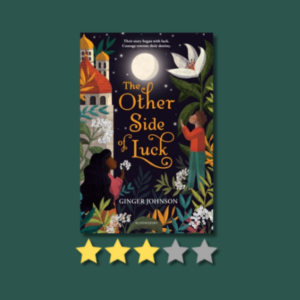
Author: Ginger Johnson
Genres: Fantasy, Middle Grade, Adventure, Childrens, Science Fiction Fantasy
Audience (Grade Levels): Upper Elementary; Grades 3-6
Number of Stars: 3-Stars
Goodreads Link: The Other Side of Luck
Triggers: Grief, death of a parent, poverty, debt collectors, arrest of a parent
Review By: Molly Clark
Publisher’s Summary:
Perfect for fans of Adam Gidwitz’s The Inquisitor’s Tale, this lyrical middle-grade fantasy follows two children from opposite circumstances as their fates cross and change both their lives forever.
Ever since her mother’s death, Princess Una has suffered through years of loneliness in the royal palace, where girls are treated as an afterthought. She yearns for a different life but is unsure how to make anyone notice her. Then her father announces a special contest: Whoever finds the rare Silva Flower can present it to Una for her twelfth birthday and receive a reward. Frustrated by her father’s grand but empty gesture, Una decides to take her fate into her own hands.
Julien, a young pauper, has tried his whole life to make something of nothing, alongside his hardworking Baba. When Baba is arrested by terrifying debt collectors, Julien’s only hope to save his father is to win the palace contest–to find the elusive Silva Flower. Little does he know that Una has decided to embark on a journey to find the prize, as well. As Una and Julien search for the flower, their destinies intertwine and offer a reward greater than anything either could ever hope for: the feeling of belonging. In this lively, heartfelt tale, Ginger Johnson treats readers to an emotionally satisfying adventure with a truly memorable cast of characters.
Review:
In The Other Side of Luck, Ginger Johnson crafts a lovely, lyrical tale focusing on two tragically motherless children, Princess Una and Julien, who each possess a fantastic and unusual gift. Una has an extreme sense of smell, allowing her to identify almost any physical object, as well as emotions, people, and plant life. Meanwhile, Julien has a profound sense of hearing, allowing him to identify plants and detect oncoming danger through sounds completely inaudible to typical humans. While Una is materially wealthy, her father’s deep grief over her mother’s death leaves her emotionally impoverished. Julien, conversely, lives in physical poverty with a loving father who sacrificed a prestigious career to care for him. Their paths inevitably cross as they both search for the rare Silva Flower: Una seeks it to recapture her mother’s scent, while Julien hopes the contest reward will rescue his family from crushing debt.
While the novel is beautifully written, creative, and emotionally resonant, I have reservations about its appeal to its intended middle-grade audience. The pacing is quite slow in the first half as the dual perspectives and unique magic systems are established. Furthermore, passive, sensory-based super powers like heightened smelling and hearing do not typically rank high on the wishlists of third through sixth graders who crave high-action magic. A quest centered around finding a flower may also fail to capture the immediate interest of reluctant readers.
Fortunately, the momentum and excitement pick up significantly in the second half when hapless marauders attempt to capture the children. These comedic and suspenseful antics will definitely appeal to younger readers—if they can stick with the slow-burn beginning long enough to reach them. For educators and librarians, this is a heartwarming story about finding a sense of belonging, but because of its quiet, literary nature, it may require handselling. It is one of those beautiful books that adults and teachers will deeply love, but I fear it may spend most of its life sitting quietly on the library shelf unless actively promoted.
Classroom & Curricular Connections:
- ELA / Literature: Excellent for comparing dual perspectives, studying sensory imagery (especially how scent and sound are personified), and analyzing how quest-driven plot structures develop character growth.
- SEL (Social-Emotional Learning): Strong connections for discussing different types of poverty (material vs. emotional), processing grief, navigating parental abandonment or loss, and exploring what it truly means to find a sense of belonging.
Readalikes:
- The Inquisitor’s Tale by Adam Gidwitz
- The Girl Who Drank the Moon by Kelly Barnhill
- The Whispering Mountain by Joan Aiken