 Published: 2020
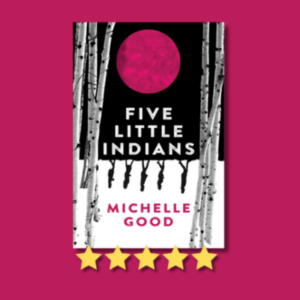
Author: Michelle Good
Genre: Historical Fiction / Indigenous Literature
Audience: High School (Grades 11–12) / Adult
Number of Stars: ★★★★★ (5/5)
Goodreads Link: Five Little Indians
Content Warnings: Trauma, systematic abuse, addiction, and death.
Publisher’s Summary
Taken from their families when they are very small and sent to a remote, church-run residential school, Kenny, Lucy, Clara, Howie and Maisie are barely out of childhood when they are finally released after years of detention. Alone and without any skills, support or families, the teens find their way to the seedy and foreign world of Downtown Eastside Vancouver, where they cling together, striving to find a place of safety and belonging in a world that doesn’t want them. The paths of the five friends cross and crisscross over the decades as they struggle to overcome, or at least forget, the trauma they endured during their years at the Mission.
Fuelled by rage and furious with God, Clara finds her way into the dangerous, highly charged world of the American Indian Movement. Maisie internalizes her pain and continually places herself in dangerous situations. Famous for his daring escapes from the school, Kenny can’t stop running and moves restlessly from job to job—through fishing grounds, orchards and logging camps—trying to outrun his memories and his addiction. Lucy finds peace in motherhood and nurtures a secret compulsive disorder as she waits for Kenny to return to the life they once hoped to share together. After almost beating one of his tormentors to death, Howie serves time in prison, then tries once again to re-enter society and begin life anew. With compassion and insight, Five Little Indians chronicles the desperate quest of these residential school survivors to come to terms with their past and, ultimately, find a way forward.
Review
This is a fabulous book! Extraordinary. Michelle Good’s Native American heritage has given her the perfect vantage point from which to write a story such as this one. I can only imagine the pain that was trudged through to make this story happen. But it is a story that needs to be shared, read, and talked about. I hurt for the characters, smiled for the characters, cheered them on, and willed them to survive.
There is no glossing over of the facts and pain this story represents, only the truth—and this truth is told through five beautiful narratives. Each narrative is the story of a Native American child’s account of Indian School and how it affected their futures and families. I wholeheartedly recommend everyone read this story just for personal understanding and empathy, but I can also see it paired with social studies classes and college Native American studies. What an amazing read; one that sticks with you forever.
🏛️ The Impact of Intergenerational Trauma
The novel functions as a collective biography showing how systemic oppression disrupts the foundational blocks of healthy psychological development.
- Loss of Cultural Anchors: By severing parental, linguistic, and cultural ties early in childhood, the residential school system enacted what sociologists call cultural genocide. Upon release, the characters struggle because their internal compasses were intentionally disrupted.
- Diverse Coping Mechanisms: Good masterfully uses five distinct points of view to show that trauma doesn’t look the same for everyone. Whether it is Kenny’s literal running, Lucy’s internal desire for order, or Clara’s outward political rage, each represents a distinct method of human survival.
- Decades-Long Echoes: The narrative structural choice to follow the characters over several decades underscores that survival is not a singular event, but a lifelong process of reclamation.
🎒 Classroom & Curricular Connections
- Social Studies & History (The Residential School System):
- Activity Idea: Primary Source Analysis. Contextualize the novel by researching the historical framework of residential schools in Canada and boarding schools in the United States. Compare the stated administrative goals of these institutions with the lived realities depicted by Good’s characters.
- Sociology & Indigenous Studies (Activism and Change):
- Activity Idea: “The History of AIM.” Clara joins the American Indian Movement (AIM). Have students research the origins, milestones, and goals of this civil rights movement during the late 20th century, exploring how grassroots activism provided a sense of agency to survivors.
- English Language Arts (The Polyphonic Novel):
- Activity Idea: “Crisscrossing Paths.” Map out a character web showing how the five viewpoints intersect over the decades in Vancouver. Discuss why the author chose to write this as a multi-perspective novel rather than focusing on just one protagonist. How does the collective voice change the impact of the story?
- Psychology & Health (Resilience and Healing):
- Activity Idea: Examine the concept of breaking cycles. Discuss how characters like Lucy attempt to build safe spaces for the next generation despite receiving no template for parenting.