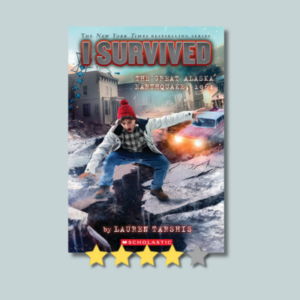
 Published: 2023
Series: I Survived #23
Genres: Historical Fiction, Adventure, Survival
Audience: Grades 3–5
Number of Stars: ★★★★☆ (4/5)
Goodreads Link: I Survived the Great Alaska Earthquake, 1964
Content Warnings: Natural disasters, destruction of property, and mild peril.
Publisher’s Summary
The Great Alaska Earthquake is the largest and most powerful recorded earthquake in US history. Lauren Tarshis’s story of one child surviving this terrifying natural disaster pounds with page-turning action and heartwarming hope. It was 1964 in the brand-new state of Alaska, a vast land of staggering beauty and heart-stopping dangers. Eleven-year-old Jack had grown up living happily with his parents in an off-the-grid cabin, miles from their closest neighbors. Grizzlies and wolves outnumbered people, and dark winter days were 30 degrees below zero. Jack had always thought of himself as strong — “Alaska tough”. But then the most powerful earthquake in American history — the Good Friday Earthquake — struck. The 9.2 magnitude quake lasted nearly five minutes, destroying downtown Anchorage and sending 30-foot tsunamis into coastal cities, wiping out entire communities. Its vibrations were felt around the world. In the end, it caused billions of dollars in damage and the death of 129 people. New York Times bestselling author Lauren Tarshis tells the story of the disaster that changed our understanding of earth science — and tested one boy in ways he never could have imagined. Includes a section of nonfiction backmatter with more facts and photos about the real-life event.
Full Review
I Survived the Great Alaska Earthquake, 1964 gives a shortened version of the historical event through the perspective of a young boy named Jackson. It was interesting to see what it was like for a kid to move out of the “bush” and into a town, adjusting to common conveniences like electricity and indoor plumbing for the first time.
However, I thought the book was missing some details that would help the reader connect more deeply with the characters. While we see the world through Jackson’s eyes, we don’t hear much from the parents’ perspective or from other children who experienced the earthquake. While the story is clearly meant for younger elementary students, more perspectives could have taught kids more about the various impacts of this tragic event.
The illustrations, including the cover, do an excellent job of drawing the reader in. From a cabin burning because of a bear encounter to the ground splitting during the quake, young readers’ eyes will be glued to the images that help explain the chaos Jackson is facing. I always recommend the I Survived series because they are shorter reads with helpful illustrations. The chapters are short and the wording is well-spaced, making them perfect for students just starting to read chapter books. Reluctant readers will enjoy these because they aren’t overwhelming.
🎒 Classroom & Curricular Connections
- Earth Science / Geography: Use the book to introduce how earthquakes happen. Discuss the specific geography of Alaska and why it is part of the “Ring of Fire.”
- Historical Comparison: Have students research life in “the bush” versus life in Anchorage in the 1960s. How did the lack of technology at the time make the disaster harder to manage?
- Perspective Writing: As the review suggested, have students write a short journal entry from the perspective of a parent or a neighbor during those five minutes of shaking.
- Survival Skills: Discuss what “Alaska tough” means and have students list items they would put in an emergency survival kit.