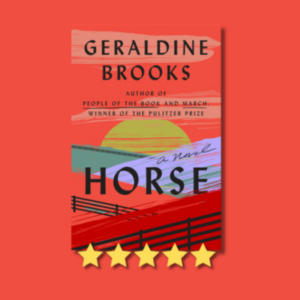
 Published: 2022
Author: Geraldine Brooks
Genres: Historical Fiction, Literary Fiction
Audience: Grade 12, Adult
Number of Stars: ★★★★★ (5/5)
Goodreads Link: Horse
Content Warnings: Racism, systemic injustice, slavery, and war-related death.
Publisher’s Summary
Based on the remarkable true story of the record-breaking Thoroughbred Lexington, Horse is a sweeping narrative that braids together three different eras of American history:
Kentucky, 1850: Jarret, an enslaved groom, forges an unbreakable bond with a bay foal that will become the greatest racehorse in U.S. history. Their journey takes them from the glamour of the track to the perils of the Civil War.
New York City, 1954: A gallery owner becomes obsessed with a 19th-century equestrian painting of mysterious origin.
Washington, D.C., 2019: A Smithsonian scientist (Jess) and a Nigerian-American art historian (Theo) connect through the stallion’s remains—one studying his bones for clues to his power, the other uncovering the lost history of the Black horsemen who made his success possible.
Full Review
What an extraordinary book! Horse is a deep dive into the realities of slavery and the horse racing industry like no other. Geraldine Brooks has a gift for drawing the reader in, making you feel as though you are living right alongside the characters.
The perspective of this novel is particularly powerful. While many of us understand the broad history of slavery, we rarely stop to contemplate the specialized roles—such as those of expert grooms and trainers—that gave enslaved individuals a unique sense of identity and agency within a brutal system. This book highlights how Black men were the true driving force behind the legends of American horse racing.
The bond between Jarret and the horse is the heart of the story, but the contemporary timeline involving Jess and Theo provides a necessary, modern reckoning with our country’s history of racism. This is a special glimpse into relationships, love, and the desperate attempts to buy one’s own freedom. I cannot recommend this novel enough; it is a perfect candidate for a book club or as supplementary reading for an upper-level classroom.
🏁 The Untold History: Black Horsemen in the 19th Century
Before the 20th century, horse racing was dominated by Black athletes and experts. Enslaved and formerly enslaved men were the premier trainers, grooms, and jockeys of the era.
The Economics of the Racetrack
For men like Jarret, the racetrack was a place of extreme contradiction: a site of immense skill and temporary status, yet still governed by the laws of bondage.
📊 Slavery and the Racing Industry: By the Numbers
To understand the scale of the history Brooks is “unbraiding,” it is helpful to look at the concrete data regarding the Black presence in early American sports:
- 1875 Kentucky Derby: In the very first Kentucky Derby, 13 out of the 15 jockeys were Black.
- Early Success: Black jockeys won 15 of the first 28 runnings of the Kentucky Derby.
- The Shift: By the early 1900s, Jim Crow laws and systemic violence effectively pushed Black horsemen out of the sport. By 1921, there were zero Black jockeys in the Derby.
- Valuation: In the mid-1800s, a champion horse like Lexington was valued at roughly $15,000 (over $500,000 today), yet the men who raised and trained him were legally considered “property” with no inherent rights.
🎒 Classroom & Curricular Connections
- US History (Civil War & Reconstruction): Use the 1850s timeline to discuss the nuances of slave labor. How did “skilled labor” differ from “field labor,” and how did the Civil War disrupt these established social structures?
- Science (Anatomy & Forensic Anthropology): Connect to Jess’s work at the Smithsonian.
-
Activity Idea: Research how scientists use osteology (the study of bones) to determine an animal’s diet, speed, and cause of death. Why was Lexington’s skeleton preserved for science?
-
- Art History (Provenance & Representation): Look at the role of the “itinerant artist” in the 19th century.
-
Activity Idea: Analyze historical equestrian paintings. Who is in the center of the frame (the horse/owner) and who is relegated to the background (the groom)? How does Theo’s work in the novel change this narrative?
-
- ELA (Narrative Braiding): Discuss how Brooks uses three timelines to create a cohesive theme. Does the 2019 storyline change how you perceive the 1850s storyline?