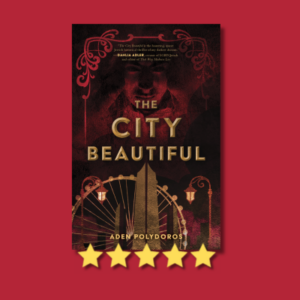
 Published: 2021
Author: Aden Polydoros
Genres: YA Historical Fiction, Fantasy, Mystery, LGBTQ+
Audience: Grades 9–12
Number of Stars: ★★★★★ (5/5)
Goodreads Link: The City Beautiful
Content Warnings: Murder, antisemitism, xenophobia, and possession/supernatural horror.
Publisher’s Summary
Chicago, 1893. For Alter Rosen, the World’s Fair represents the “land of opportunity.” He works tirelessly to save enough money to bring his mother and sisters to America, escaping the brutal oppression they face in Romania. But his dream turns into a nightmare when his best friend, Yakov, becomes the latest victim in a string of murdered Jewish boys.
While the rest of Chicago celebrates the “White City,” Alter is plunged into a world of corruption. He becomes possessed by Yakov’s dybbuk—a restless spirit—which compels him to find the killer. With the help of a dangerous boy from his past, Alter must race against time to track down the murderer before the dybbuk takes over his body completely or the killer claims him as the next victim.
Full Review
The City Beautiful is a gripping historical novel that masterfully blends the grit of 1893 Chicago with Jewish folklore. Aden Polydoros provides a powerful lens into the immigrant experience, highlighting the harsh realities of poor working conditions and the widespread discrimination faced by Jewish communities at the turn of the century.
What starts as a historical drama quickly shifts into a dark, supernatural mystery. The use of the dybbuk—an otherworldly force—serves as a haunting metaphor for the grief and the literal “ghosts” immigrants carry from their homelands. The vivid descriptions of the World’s Fair contrast sharply with the shadows of the tenements, making the setting a character in its own right.
Beyond the suspense, the novel highlights the strength of friendship and the complexities of identity and assimilation. It offers a meaningful opportunity for students to draw comparisons between historical and contemporary issues surrounding immigration. This is an unforgettable story about justice, empathy, and the resilience required to survive in an unfamiliar and often hostile world.
🎡 The World’s Columbian Exposition of 1893
The novel is set against the backdrop of the Chicago World’s Fair, known as the “White City.” While it was a marvel of innovation, it masked a darker side of Chicago’s history. The Contrast of the “City Beautiful” – Alter’s experience highlights the disparity between the Fair’s grandeur and the immigrant struggle.
📜 Jewish Folklore: The Dybbuk
A central element of the plot is the dybbuk. In Jewish mythology, a dybbuk is the disembodied spirit of a deceased person that possesses a living body to achieve an unfinished goal or seek justice.
- In the Novel: Yakov’s spirit inhabits Alter to ensure his murderer is brought to justice.
- Thematically: The dybbuk represents the weight of the past and the communal trauma of the Jewish people fleeing pogroms in Europe.
🎒 Classroom & Curricular Connections
-
US History (The Gilded Age & Immigration): Study the “Great Wave” of immigration from 1880–1920.
Activity Idea: Compare Alter’s journey from Romania to the experiences of real immigrants at Ellis Island. How did the 1893 World’s Fair influence the “American Dream” narrative?
-
ELA (Gothic Elements & Mystery): Analyze how Polydoros uses the supernatural to enhance a historical mystery.
Activity Idea: Identify the tropes of “Gothic Horror” present in the book (possession, dark secrets, urban decay). How does the supernatural element make the social commentary on antisemitism more impactful?
-
Sociology (Assimilation & Identity): Explore the pressure on immigrants to assimilate into American culture while maintaining their religious identity.
Activity Idea: Discuss the “Melting Pot” vs. the “Salad Bowl” theories of integration. Where does Alter fall on this spectrum?
-
Religious Studies (Jewish Traditions): Look at the specific rituals and folklore mentioned in the book.
Activity Idea: Research the significance of the Hevra Kadisha (Jewish burial society) mentioned in the story. Why is a proper burial so central to the resolution of a dybbuk possession?