 Review by: Heather Turner
Published: 2025
Author: Andie Powers
Illustrator: Lucy Rose
Genres: Nonfiction Picture Book, Astronomy, Zoology
Audience: Pre-K–Grade 3
Number of Stars: ★★★★★ (5/5)
Goodreads Link: Wild Moon
Publisher’s Summary
A lyrical picture book featuring the eight lunar phases of the moon and how they affect wildlife on Earth told from the perspective of the moon.
Gold, Science Spark, Big Bang Notable Book List 2025
“This is a beautifully rendered piece of science, with enough poetic expression to draw in readers, but never growing sentimental or fantastical with the facts. The paintings are meant to be pored over, and this is likely not a book for reading once. It will certainly enliven story hours with its combination of repose and activity, all in one moon cycle….A generous view of the phases of the moon, written with great care, pacing, and illumination.”—School Library Journal, Starred Review
“This beautifully illustrated picture book not only presents the eight phases of the moon but also how animals from various habitats adapt during these phases….Fitting dark backgrounds with luminous light that showcase nature’s nighttime vibrancy set each scene….[an] attractive STEM selection.”—Booklist Magazine
Some of Earth’s most extraordinary creatures have fascinating connections to our elegant and mysterious friend, the Moon. Did you know that the low glow of a waxing crescent moon helps dung beetles scurry home? Or that coral spawns when the Moon is full?
Wild Moon sheds light on the fascinating behavior of some of the Earth’s most extraordinary creatures in this whimsical nonfiction picture book, perfect for fans of MOON! Earth’s Best Friend and Bedtime for Bo.
Review
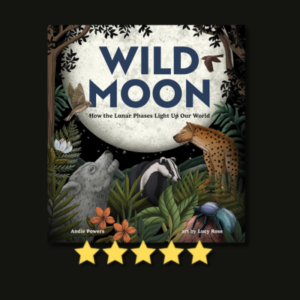
This beautifully illustrated nonfiction picture book offers a lyrical and engaging exploration of the moon and its phases. The artwork is particularly striking, capturing the quiet beauty of nighttime with rich, atmospheric visuals. The cover itself features a subtle shimmer that immediately draws the reader in and would likely appeal to children browsing the shelves. While the illustrations are strong overall, I did find myself wishing for an added interactive element, such as glow-in-the-dark features, especially since bioluminescent creatures like scorpions are mentioned.
The text skillfully blends factual information with poetic verse, creating a balance that makes complex scientific ideas accessible without oversimplifying them. The book moves through the phases of the moon and pairs each phase with animals that depend on varying levels of moonlight. This approach offers a unique and memorable way to introduce lunar cycles. I was particularly intrigued by the inclusion of terms like micromoon, supermoon, and blood moon, along with explanations behind these phenomena. However, I was surprised that tidal patterns were not addressed, as they are a natural extension of the topic.
The themes center on the interconnectedness of nature and the subtle ways light influences behavior in the natural world. Despite the sophistication of these ideas, the presentation remains highly approachable for elementary-aged readers. This title would work well as a read aloud, especially when paired with discussion or inquiry-based science lessons. It also lends itself to cross curricular connections in poetry and observational writing.
Students who are drawn to nature and nonfiction will likely gravitate toward this book, and the visually appealing cover will help with initial engagement. As a follow-up activity, students could track moon phases, write their own moon-inspired poems, or research nocturnal animals. Having also read I Am Quiet: A Story for the Introvert in All of Us by the same author, I found this title to be stronger in both concept and execution, suggesting growth in the author’s craft. Overall, I would highly recommend this book for elementary collections, particularly for classrooms and libraries seeking engaging, science-focused picture books.
🐾 Nature Under the Moonlight
- Navigation: Dung beetles use the soft light of the waxing crescent moon to scurry in a straight line back to their homes.
- Reproduction: Many species of coral wait for the specific light of a full moon to release their eggs and sperm in a massive, synchronized spawning event.
- Bioluminescence: Some creatures, like certain scorpions, glow under the moon’s UV light, which helps them sense their surroundings.
🎒 Classroom & Curricular Connections
-
Science (Astronomy & Cycles): Use the book to introduce the concept of predictable patterns in nature.
-
Activity Idea: Have students keep a “Moon Journal” for one month, drawing the shape of the moon each night.
-
-
ELA (Poetry and Personification): The book is told from the Moon’s perspective.
-
Activity Idea: Write a “Perspective Poem.” Have students choose an object in the sky (the Sun, a star) and write a short poem from its point of view.
-
-
Art (Atmospheric Painting): Analyze how Lucy Rose uses dark backgrounds to make the light “pop.”
-
Activity Idea: Use black paper and white/yellow chalk to recreate a specific phase of the moon, focusing on the “glow” effect.
-