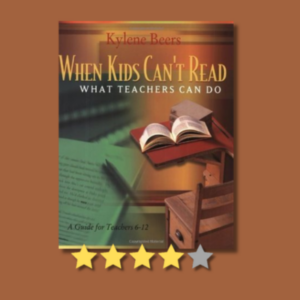
 Author: Kylene Beers
Published: 2023 (Latest edition/printing)
Genre: Professional Development / Education
Audience: Educators (Grades 6–12)
Number of Stars: ★★★★☆ (4/5)
Goodreads Link: When Kids Can’t Read
Publisher’s Summary
For Kylene Beers, the question of what to do when kids can’t read surfaced abruptly in 1979 when she began teaching. That year, she discovered that some of the students in her seventh-grade language arts classes could pronounce all the words, but couldn’t make any sense of the text. Others couldn’t even pronounce the words. And that was the year she met a boy named George.
George couldn’t read. When George’s parents asked her to explain what their son’s reading difficulties were and what she was going to do to help, Kylene, a secondary certified English teacher with no background in reading, realized she had little to offer the parents, even less to offer their son. That defining moment sent her on a twenty-three-year search for answers to that original question: how do we help middle and high schoolers who can’t read?
Now in her critical and practical text “When Kids Can’t Read – What Teachers Can Do: A Guide for Teachers 6-12,” Kylene shares what she has learned and shows teachers how to help struggling readers with comprehension vocabulary fluency word recognition motivation Here, Kylene offers teachers the comprehensive handbook they’ve needed to help readers improve their skills, their attitudes, and their confidence. Filled with student transcripts, detailed strategies, reproducible material, and extensive booklists, this much-anticipated guide to teaching reading both instructs and inspires.
Review
As a teacher, I found When Kids Can’t Read, What Teachers Can Do by Kylene Beers to be an incredibly practical and relevant resource. If you are a teacher who has students struggling to read, this is the book for you. It clearly walks you through key aspects of literacy instruction and provides a wide range of strategies that you could realistically implement with your upper-level students as soon as the next day.
What stood out most to me was how student-friendly and accessible the strategies are. Beers does an excellent job of breaking down complex reading challenges and offering concrete solutions that empower both teachers and students. While some of the visuals and pictures in the book felt a bit dated, the core ideas and instructional approaches remain highly effective and applicable in today’s classrooms.
I would strongly recommend this book to teachers of all content areas, not just English or reading specialists. Whether you teach science, social studies, or math, this book provides valuable insight into how to support struggling readers and, ultimately, help create more confident and capable learners.
🧠 Core Literacy Pillars for Secondary Students
Beers emphasizes that reading instruction shouldn’t end in elementary school. The text addresses four primary barriers to literacy in grades 6–12.
Key Strategies for the Classroom
- Comprehension: Strategies to move students beyond “barking at print” (pronouncing words without meaning) toward deep understanding.
- Fluency: Practical ways to build the speed and accuracy needed for older students to process complex disciplinary texts.
- Motivation: Techniques to re-engage students who have “given up” on reading due to years of academic frustration.
- Word Recognition: Addressing the underlying gaps in decoding that persist even into high school.
🎒 Teacher Toolkit: Implementation Ideas
This book is highly regarded for its “read-on-Monday, implement-on-Tuesday” approach. Here is how it can be utilized across departments:
- For Science/Math Teachers: Use Beers’ “Before/During/After” reading strategies to help students parse complex textbook directions or lab reports.
- For Social Studies Teachers: Utilize the suggested booklists to find high-interest, low-readability historical fiction that provides context for your curriculum.
- For All Teachers: Implement the “Think-Aloud” strategy where teachers model their own internal dialogue while reading a difficult passage, showing students how to monitor their own understanding.
📝 Why Literacy is a “Whole School” Responsibility
Beers argues that “every teacher is a teacher of reading.” When students hit a wall in biology or history, it is often because their literacy foundation isn’t strong enough for the academic level of the text. By using these strategies, content-area teachers can:
- Reduce frustration: When students know how to approach a tough text, they are less likely to act out or disengage.
- Increase accessibility: Breaking down vocabulary and syntax ensures that learning content is about the subject matter, not just the student’s reading level.
- Build self-efficacy: As students gain confidence in their ability to decode and comprehend, their overall performance in the classroom improves.