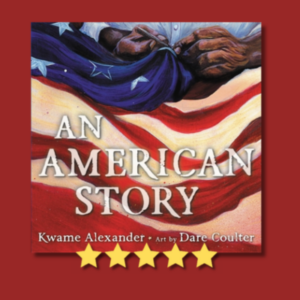
 Published: 2023
Author: Kwame Alexander | Illustrator: Dare Coulter
Genres: Picture Book, Historical Nonfiction, Poetry
Audience: Grades 3–8
Number of Stars: ★★★★★ (5/5)
Goodreads Link: An American Story
Content Warnings: Intense emotional content regarding the horrors of slavery, the brutality of the transatlantic slave trade, and scenes depicting inhuman treatment.
Publisher’s Summary
#1 New York Times Bestselling and award-winning author of The Undefeated , Kwame Alexander, pens a powerful picture book that tells the story of American slavery through the voice of a teacher struggling to help her students understand its harrowing history.
From the fireside tales in an African village, through the unspeakable passage across the Atlantic, to the backbreaking work in the fields of the South, this is a story of a people’s struggle and strength, horror and hope. This is the story of American slavery, a story that needs to be told and understood by all of us. A testament to the resilience of the African American community, this book honors what has been and envisions what is to be.
With stunning mixed-media illustrations by newcomer Dare Coulter, this is a potent book for those who want to speak the truth. Perfect for family sharing, the classroom, and homeschooling.
Review
Kwame Alexander’s An American Story is a powerful and emotional picture book that introduces young readers to the history of slavery in a way that is honest, poetic, and thought-provoking.
In lyrical verse, the book follows a teacher guiding students through the difficult history of slavery. It begins in Africa, showing culture and community, before moving into the painful realities of the transatlantic slave trade and life in America. Throughout the story, students ask questions, react emotionally, and help shape the discussion—making the narrative feel real and relatable.
The poetic writing makes a heavy topic accessible without minimizing its seriousness. The classroom dialogue allows readers (especially kids) to connect and ask their own questions. The mixed-media illustrations by Dare Coulter add depth and emotion, blending past and present in visually striking ways. The book emphasizes both the cruelty of slavery and the resilience, courage, and hope of African Americans.
This is not an “easy” read, but it is an important one. It is “powerful” and “essential,” especially for classrooms, because it helps adults and children begin meaningful conversations about a difficult part of history. An American Story stands out because it doesn’t avoid hard truths—it invites young readers to face them with empathy and understanding.
🏛️ Understanding the Context
To understand the scope of the history discussed in the book, it is helpful to visualize the scale and geography of the trade.
Key Historical Pillars
- The Middle Passage: The horrific sea journey where millions of enslaved Africans were forcibly transported in inhumane conditions.
- Resilience and Agency: While the history is one of “horror,” the book also focuses on the “strength” of the people, their culture, and their fight for freedom.
- The Classroom Perspective: By framing the story as a classroom discussion, Alexander models how students can grapple with difficult history through inquiry and empathy.
🎒 Classroom & Curricular Connections
This book is intended for guided discussion. Here are the questions used by the reviewer to facilitate a deep dive with fourth-grade students:
- Reflective Inquiry: Why do you think the author included students’ voices in the story? How might this story be different if it was told without the classroom discussion?
- Historical Empathy: What questions do you still have after reading? What is one thing you learned that you didn’t know before?
- Application: How can we show kindness, fairness, and respect to others in our own lives?
Facilitating Difficult Conversations
- Adult Support: Because the imagery is intense, this book should be read with an adult who can help children process their emotions and provide historical context.
- Focus on Resilience: Use the text to shift the narrative from solely focusing on the “horror” to honoring the courage and hope that allowed enslaved people to survive and contribute to the American story.