 Reviewer: Jenna Ballard
Published: 2024
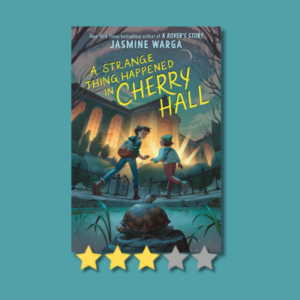
Author: Jasmine Warga
Genre: Middle Grade Mystery / Magical Realism
Audience: Grades 5–8
Number of Stars: ★★★☆☆ (3/5)
Goodreads Link: A Strange Thing Happened in Cherry Hall
Content Warnings: None (A gentle, “cozy” mystery).
Publisher’s Summary
From the award-winning, New York Times bestselling author of A Rover’s Story and Other Words for Home comes an extraordinary story about two friends, a ghost, a missing painting, and a turtle named Agatha. The perfect next read for fans of The Swifts, Kate DiCamillo, and Erin Entrada Kelly.
A painting has been stolen…!
When Rami sees a floating girl in the museum, he knows he has seen her somewhere before. Then he realizes: She looks just like the girl in the painting that has gone missing. But how does her appearance connect to the theft?
Agatha the turtle knows—she has been watching from the garden. But she can’t exactly tell anyone…can she?
Will Rami, with the help of his classmate, Veda, be able to solve the mystery? The clues are all around them, but they’ll have to be brave enough to really look.
This is a whimsical, moving story about the universal desire to be seen and understood and how art can help us find connection, even when we are at our loneliest.
Review
Rami is an eleven (almost twelve)-year-old boy who has been spending a lot of time on his own lately. His old friends don’t seem to want to hang out with him anymore. One afternoon he’s wandering around the art museum where his mom works—the museum where, it also happens, a painting was recently stolen! No one knows who took it or why, but Rami is worried that his mother will end up being a suspect.
And, it turns out, Rami only thinks he’s alone that afternoon—until he sees a floating girl in the room with him. It’s the girl from the missing painting! Is she a ghost? A mirage? A figment of his imagination? Why is she there, and what has happened to the missing painting? Rami gets swept up in solving the mystery, along with a spunky classmate (a maybe new friend?) named Veda.
This is a sweet story with nearly equal elements of mystery, magical realism, and everyday middle school friendship. The style and narrative voice lend a cozy and conversational feel throughout the novel, which hovers just around 200 pages of relatively short chapters. I listened to the audiobook, borrowed on Sora, which was enjoyable to breeze right through. This is a great low-stakes mystery for younger readers (5th or 6th grade) who enjoy a story about kids searching for clues but don’t want anything grim or gruesome. On the other hand, readers looking for even a little bit of grit or sense of danger might be disappointed (the “thief” is not a villain and acted for noble reasons).
✨ Understanding Magical Realism
This novel is a perfect introduction to the genre of Magical Realism. Unlike high fantasy (where the whole world is magical), magical realism places one extraordinary element into an otherwise normal, “real” world.
- The “Magic”: In this book, the magic is the presence of the girl from the painting.
- The “Realism”: The setting is a standard art museum, and the protagonist deals with common middle school issues like shifting friendships and loneliness.
- The Purpose: The magical element usually serves as a metaphor for the character’s internal feelings—in this case, the “invisible” girl mirrors Rami’s own feeling of being unseen by his peers.
🎒 Classroom & Curricular Connections
- Art History (Famous Heists):
- Activity Idea: Use the book as a jumping-off point to research real-life art heists, such as the 1990 Isabella Stewart Gardner Museum theft. Discuss: Why do people steal art if it’s too famous to sell?
- ELA (Point of View & Personification):
- Activity Idea: The book features “observations” from Agatha the turtle. Have students write a short scene of a school event from the perspective of a classroom pet. What do they see that the humans miss?
- Social-Emotional Learning (The “Invisible” Student):
- Activity Idea: Rami feels “unseen.” Conduct a “Connection Circle” where students discuss what makes them feel truly “seen” by their friends or teachers.
- Art & Values:
- Activity Idea: Have students choose a “missing” painting (real or fictional) and write a “Noble Reason” for why someone might “borrow” it, rather than steal it for money. This explores the concept of ethics vs. law mentioned in the review.