 Reviewer: Susan Collins
Published: 2018
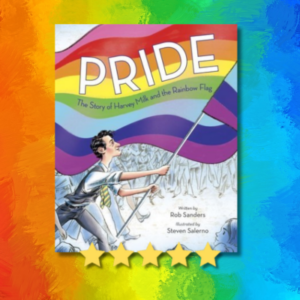
Author: Rob Sanders | Illustrator: Steven Salerno
Genre: Nonfiction Picture Book / Biography / History
Audience: Grades 2–8 (Best suited for Grades 1–4)
Number of Stars: ★★★★★ (5/5)
Goodreads Link: Pride: The Story of Harvey Milk and the Rainbow Flag
Themes: Civil Rights, Activism, Identity, Community, Hope.
Publisher’s Summary
The very first picture book about the remarkable and inspiring story of the Gay Pride Flag! In this deeply moving and empowering true story, young readers will trace the life of the Gay Pride Flag, from its beginnings in 1978 with social activist Harvey Milk and designer Gilbert Baker to its spanning of the globe and its role in today’s world. Award-winning author Rob Sanders’s stirring text, and acclaimed illustrator Steven Salerno’s evocative images, combine to tell this remarkable—and undertold—story. A story of love, hope, equality, and pride.
Review
Pride: The Story of Harvey Milk and the Rainbow Flag is an inspiring nonfiction picture book that introduces young readers to the history of the rainbow pride flag and the activism of Harvey Milk. The book combines simple but powerful storytelling with bright, energetic illustrations that capture the spirit of hope and equality.
One of the book’s greatest strengths is how it explains an important moment in LGBTQ+ history in a way elementary students can understand. The story focuses on Harvey Milk’s dream of equality and the creation of the flag by artist Gilbert Baker. The language is accessible for younger readers while still introducing meaningful themes such as courage, activism, and community. Even difficult historical events, including Harvey Milk’s assassination, are handled gently and age-appropriately without graphic detail.
Recently, controversy arose in Hanover County, Virginia, after a parent complained about the book being read in a second-grade classroom. Despite being labeled as “sensitive material” by some, many parents and the National Coalition Against Censorship (NCAC) have spoken out in support, arguing that the book—which contains no references to sex or violence—is a civil rights story at its core. It is a strong choice for fourth-grade read-alouds as it encourages students to think about how individuals can create positive change and how communities grow stronger when everyone feels seen and valued.
🎨 The Language of Color: The Original 1978 Flag
In 1978, Gilbert Baker designed the first flag with eight colors, each representing a specific meaning. Understanding these symbols helps students see the flag as more than just a rainbow—it is a map of human values.
- Symbolism: Gilbert Baker chose a rainbow because it is a natural “flag from the sky” that represents all people.
- Evolution: Over time, the flag changed to six colors (removing pink and turquoise) for easier mass production, but the core message of “Hope” remained the same.
- The Power of Symbols: Just like a country’s flag or a school’s mascot, the Pride flag was created to give a community a sense of belonging and visibility.
🎒 Classroom & Curricular Connections
- Social Studies (Civil Rights Movements):
- Activity Idea: Compare Harvey Milk’s activism with other civil rights leaders studied in class (e.g., Martin Luther King Jr. or Cesar Chavez). Discuss the common theme of “standing up for others” and fighting against bigotry.
- ELA (Biographies & Symbols):
- Activity Idea: Analyze the back matter of the book. Have students create a timeline of the Pride Flag’s history using the photographs and resources provided in the text.
- Art & Design (Personal Symbols):
- Activity Idea: Harvey Milk and Gilbert Baker wanted a symbol that represented “Hope.” Have students design their own flag that represents a value they care about (e.g., Kindness, Environmentalism, Bravery). What colors would they choose and why?
- Anti-Bullying & SEL (Inclusion):
- Activity Idea: Discuss the concept of “belonging.” How does seeing a symbol like the rainbow flag make someone feel welcomed? Connect this to the district’s anti-bullying curriculum regarding respect for all identities.
🛡️ Note on Intellectual Freedom
As this book has been a target for censorship, it serves as an excellent case study for middle and high school students regarding First Amendment Rights and the Freedom to Read.
“Books that tell LGBTQ stories are disproportionately censored… empowers youth to lead change in their communities.” — National Coalition Against Censorship