 Series: Berrybrook Middle School (Book 5)
Published: 2022
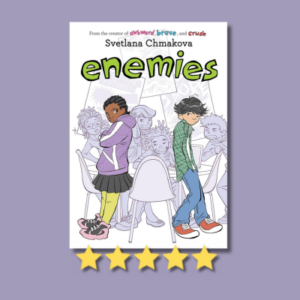
Author / Illustrator: Svetlana Chmakova
Genre: Middle Grade Graphic Novel / Realistic Fiction
Audience: Grades 5–8
Number of Stars: ★★★★★ (5/5)
Goodreads Link: Enemies
Themes: Handling Failure, Sisterly Rivalry, Healthy Communication, Evolving Friendships, Perfectionism.
Publisher’s Summary
Felicity’s sure she’s going to do something big. Exactly what that is remains a mystery, but she’ll figure it out. Her sister, Letty, constantly teases her that she never finishes anything she starts, but Felicity thinks that’s just because Letty is the family “perfect child.” Still, middle school life is mostly good, packed with plenty of friends, sketching with the art club, and playing games with her buddies.
But when an entrepreneurship contest is announced, Felicity decides to join to prove to Letty—and herself—that she can finish a major project. As the competition heats up, stress levels spike, and Felicity begins to wonder if turning friends into enemies is easier than she ever thought. What does it even mean to be enemies? And who is it that she needs on her side the most when things go wrong?
Review
I really enjoyed this book and was so excited to dive back into Svetlana Chmakova’s incredibly popular, well-loved Berrybrook Middle School universe! Typically, I love stories that end perfectly wrapped up in a nice, happy bow. However, what makes Enemies stand out so beautifully is its realistic discussion that it is completely normal to experience failure in life, and that absolutely no one is perfect. This message is profoundly important for the middle school age group. Very few children’s stories end with the main character losing a competition or dealing with things not working out exactly how they planned.
The book brilliantly portrays the toxic dynamic of a sibling feeling like they live entirely in the shadow of a “golden child” sister, showing the realistic resentment that builds—and how, in the end, they can actually learn to work together. It also places a heavy, wonderful emphasis on the importance of honest communication among friends. I loved watching Felicity struggle with, yet ultimately succeed at, speaking her mind. Being open about your boundaries is incredibly difficult at that age, and honestly, it remains difficult even as an adult. The ultimate takeaway of this five-star graphic novel is magnificent: it promotes direct communication as the best way to overcome relationship difficulties, while gently reminding readers that some friendships naturally drift apart over time—and that is completely okay!
🎒 Classroom & Curricular Connections
- Social-Emotional Learning (Redefining Success & Dealing with Failure):
- Activity Idea: “The Upside of Falling Short.” Felicity does not win the contest, which breaks traditional story tropes. Have students write a short reflection or hold a circle discussion about a time they didn’t win a game, messed up a project, or failed a test. What did they learn from the experience, and how did it make them more resilient?
- English Language Arts & Drama (The Sibling Shadow Chart):
- Activity Idea: Letty is perceived as the “perfect child,” which deeply skews Felicity’s self-esteem. Have students track the interactions between the sisters across the graphic novel. Create a comparison chart showing Felicity’s internal assumptions about Letty versus the actual reality of Letty’s thoughts and pressures, highlighting the dangers of comparison.
- Communication Workshops (Using ‘I’ Statements):
- Activity Idea: Felicity struggles to speak her mind honestly, which leads to her friendships fracturing into “enemy” territory. Teach students how to construct healthy “I-Statements” to express frustration without attacking others (e.g., “I feel frustrated when my ideas are ignored because I want to help our group project”). Have them practice role-playing scenes from the book where characters chose silence or anger over honest dialogue.
- Art & Graphic Novel Studies (Visualizing Emotional Conflict):
- Activity Idea: Chmakova is famous for using exaggerated expressions, tiny background chibi characters, and shifting color backdrops to display middle school anxiety. Have students select a 3-panel sequence where Felicity is feeling stressed or anxious and analyze how the artist conveys that emotion purely through visual cues rather than text.