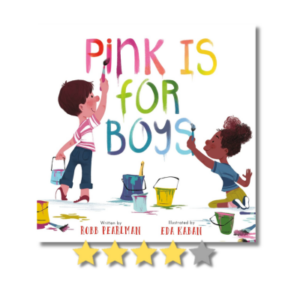
 Published: 2018 (Board Book Edition: 2021)
Author: Robb Pearlman | Illustrator: Eda Kaban
Genre: Children’s Picture Book / Educational Concept Book
Audience: Pre-K–Grade 3
Number of Stars: ★★★★☆ (4/5)
Goodreads Link: Pink Is for Boys
Themes: Shattering Gender Stereotypes, Color Identification, Inclusivity, Self-Expression.
Review by: Megan Powell
Publisher’s Summary
An empowering and educational board book that proves colors are for everyone, regardless of gender.
Pink is for boys . . . and girls . . . and everyone! This timely and beautiful book rethinks and reframes the stereotypical blue/pink gender binary and empowers kids—and their grown-ups—to express themselves in every color of the rainbow. Featuring a diverse group of relatable characters, Pink Is for Boys invites and encourages children to enjoy what they love to do, whether it’s racing cars and playing baseball, or loving unicorns and dressing up. Vibrant illustrations help children learn and identify the myriad colors that surround them every day, from the orange of a popsicle to the green of a grassy field. Parents and kids will delight in Robb Pearlman’s sweet, simple script, as well as its powerful message: life is not color-coded.
Review
This book utilizes a beautifully straightforward layout where each page highlights a single color theme to deliver an easy, accessible read. At its core, the story breaks down the idea that colors belong to specific genders, demonstrating instead that every color in the rainbow is for any child, boy or girl alike. As the pages turn, the narrative gently expands its scope, shifting from basic color associations to a much broader, inclusive message: that any activity, hobby, or interest is open to anyone. The book concludes beautifully on a poetic note: “And flowers. And butterflies. And rainbows in the sky.” I highly recommend this book for early childhood students in the 3rd grade or lower. While the words and illustrations are incredibly simple and friendly for early readers, the underlying message is much deeper and socially significant. For educators looking to add this to a classroom library, it is worth noting that some parents may hold mixed feelings regarding books that challenge traditional gender norms, which is simply something to keep in mind for community context. Overall, however, this is a wonderfully nice, light, and uplifting read that truly has something positive to offer everyone.
🎒 Classroom & Curricular Connections
- Early Literacy & Concept Development (Color Matching & Grammar):
- Activity Idea: “Colors are for Everyone” Sorting Game. Create a classroom chart featuring all the colors mentioned in the book. Instead of sorting items by traditional gender associations, have students draw or cut out pictures of things they personally enjoy that match those colors (e.g., a green soccer ball, a pink race car, a blue unicorn).
- Social-Emotional Learning (Deconstructing Stereotypes):
- Activity Idea: “Life is Not Color-Coded.” Use the book’s central premise to talk about toys and activities. Pass around a toy catalog and discuss how certain pages are often coded in bright pinks or dark blues. Ask students to re-imagine a toy box where all children play together, focusing on what they love to do rather than what color the packaging is.
- Art & Creative Self-Expression:
- Activity Idea: “My Rainbow Self.” Have students paint or color a self-portrait using their absolute favorite colors, regardless of societal expectations. On the back, have them complete the sentence stem: “I like [color] because it reminds me of [favorite activity/object].”
- Community & Parent Engagement Navigation:
- Activity Idea: To proactively address potential mixed feelings from families, pair the reading of this book with an informational note home highlighting its use as a standard tool for vocabulary building, color identification, and promoting basic kindness and inclusivity on the playground.