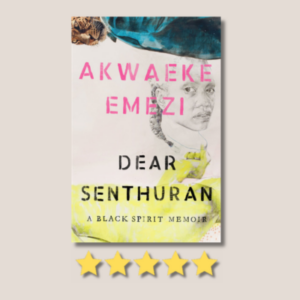
 Published: 2021
Author: Akwaeke Emezi
Genre: Non-Fiction Memoir / Epistolary Essays
Audience: Adult (Ages 18+)
Number of Stars: ★★★★★ (5/5)
Goodreads Link: Dear Senthuran: A Black Spirit Memoir
Content/Trigger Warnings: Detailed depictions of suicide and suicide attempts, chronic depression, graphic self-harm imagery, visceral and cannibalistic anatomical metaphors, and strong language.
Diversity: Centers non-binary/transgender identity, Igbo spiritual cosmologies, and Black indigenous divinity.
Review by: Stephanie Kenific
Publisher’s Summary
A full-throated and provocative memoir in letters from the New York Times-bestselling author, “a dazzling literary talent whose works cut to the quick of the spiritual self.” —Esquire
In three critically acclaimed novels, Akwaeke Emezi has introduced readers to a landscape marked by familial tensions, Igbo belief systems, and a boundless search for what it means to be free. Now, in this extraordinary memoir, the bestselling author of The Death of Vivek Oji reveals the harrowing yet resolute truths of their own life. Through candid, intimate correspondence with friends, lovers, and family, Emezi traces the unfolding of a self and the unforgettable journey of a creative spirit stepping into power in the human world. Their story weaves through transformative decisions about their gender and body, their precipitous path to success as a writer, and the turmoil of relationships on an emotional, romantic, and spiritual plane, culminating in a book that is as tender as it is brutal. Electrifying and inspiring, animated by the same voracious intelligence that distinguishes their fiction, Dear Senthuran is a revelatory account of storytelling, self, and survival.
Review
I found this book to be totally captivating and 100% worth reading as an adult. Because I previously only knew Emezi as the brilliant author of young adult novels like Pet and Bitter, I didn’t initially realize that this book’s target demographic—and possibly the author’s primary audience—is actually adults. While moving through the chapters, I kept thinking of all the people I wanted to pass this memoir onto, deeply wishing I had read it back in college when I was actively exploring the genre as an aspiring writer.
Emezi’s bold, transcendent declaration that they are an ogbanje—a little god learning to be a big god, to be precise—was exactly what I needed to read in this exact moment. At its core, the book is about learning to entirely tune out external criticism, especially when that voice comes from your own self-deprecating internal commentary. This book fundamentally taught me to see myself as a deeper spiritual entity worthy of respect, while simultaneously honoring the inherent divinity of others. Emezi’s masterful writing will undoubtedly stay with me for a very long time.
I am incredibly glad I read this book. However, from an educational standpoint, I also discovered that I unfortunately need to remove it from my high school library’s collection. While I personally gleaned an immense amount of wisdom from the text, it is also incredibly dark and far too mature for teenagers. For a significant majority of the book, Emezi frames their existence around an intense desire to die by suicide, describing several of their past attempts in raw, granular detail. There is also a heavily visceral—and, I think, profoundly metaphorical—essay in which Emezi describes a desire to cut and consume their lover’s flesh.
While I was fully able to extract deep literary meaning from these passages, and Emezi does beautifully conclude that they choose life at the end, the sheer amount of graphic darkness is concerning. I worry it could be far more harmful than helpful to vulnerable young people who might be struggling with suicidal ideation themselves.
It is a book that I hope my teenagers will eventually find on their own as adults, but one that I cannot in good conscience hand to them right now. I truly believe it is meant for readers who have accomplished at least a solid decade of adult life. The profound meditations on shifting relationships, evolving friendships, and cutthroat creative career-building are deeply worthwhile, but they risk being entirely lost on a younger audience.
🌌 The Ogbanje Framework: Spirit vs. Human World
Emezi rejects traditional Western psychological frameworks for processing trauma and gender identity, leaning instead into indigenous Igbo spiritual concepts to articulate their lived experience.
- The Metaphor of Consumption: The reviewer highlights a jarring essay detailing the desire to consume a lover’s flesh. In Emezi’s spiritual lexicon, love and boundary lines are not polite; they are absolute and cosmic. The cannibalistic metaphor represents a desire for total, non-dualistic integration with the beloved, stripping away the fragile limits of human skin.
- The Epistolary Safety Net: By structuring the memoir as a series of intimate letters (“Dear Senthuran,” “Dear Toni,” etc.), Emezi grounds their heavy metaphysical shifts within concrete relationships. The letters act as literal lifelines, holding the spirit tethered to the physical world while they unpack the agonizing process of choosing to stay alive.
🎒 Curricular, Library, & Institutional Insights
- Library Media Selection & Collection Audits (The Nuance of Weeding):
- Activity/Discussion Blueprint: Use the reviewer’s professional dilemma to illustrate the critical difference between censorship and age-appropriate collection development. The reviewer recognizes the book’s flawless 5-star literary merit but notes that its raw descriptions of suicide attempts present a psychological safety concern for a high school media center.
- Framework Check: When auditing texts with heavy trigger warnings, library media specialists can utilize a collection rubric that evaluates whether the structural processing of trauma requires an adult emotional literacy baseline, mapping out alternative YA path-builders like Emezi’s own Pet.
- Higher Education / Creative Writing (The Boundaries of the Memoir Genre):
- Activity Idea: “The Epistolary Memoir.” For college-level literary courses, analyze how Dear Senthuran expands the boundaries of traditional autobiography. Have students compare Emezi’s letters with Ta-Nehisi Coates’s Between the World and Me or James Baldwin’s The Fire Next Time. Analyze how addressing a specific person changes the vulnerability, tone, and pacing of non-fiction prose compared to addressing a general public reader.
- Comparative Literature & Religious Studies (Igbo Cosmology in Modern Text):
- Activity Idea: “De-Centering Western Lenses.” Explore the concept of the ogbanje (an intrusive spirit that cycles through birth and death) as featured in Chinua Achebe’s classic Things Fall Apart alongside Emezi’s modern memoir. Have advanced students analyze how indigenous spiritual frameworks can redefine contemporary trans/non-binary identity narratives outside of modern Western medicalized terminology.