 Published: 2023
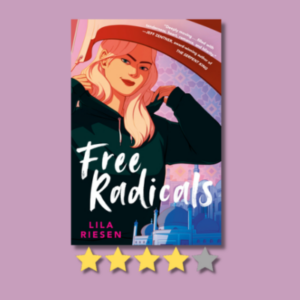
Author: Lila Riesen
Genre: Young Adult Realistic Fiction / Contemporary Fiction / OwnVoices
Audience: Grades 9–12 (High School)
Number of Stars: ★★★★☆ (4/5)
Goodreads Link: Free Radicals
Content/Trigger Warnings: Underage drinking, casual and systemic racism, localized school violence, references to wartime trauma, and mentions of sexual assault/toxic rumors.
Diversity: Centers an Afghan-American teenage protagonist, explores Muslim-American family dynamics, and features a diverse supporting cast including Black and LGBTQ+ characters.
Review by: Stephanie Kenific
Publisher’s Summary
Afghan-American Mafi’s sophomore year gets a whole lot more complicated when she accidentally exposes family secrets, putting her family back in Afghanistan in danger in this smartly written YA debut.
Sixteen-year-old Mafi Shahin knows life is not always fair. If it were she’d have just as much freedom as her older brother Rafi and her crush—basketball star Jalen Thomas—would see her as more than Rafi’s kid sister. And if life were fair, Mafi’s family in Afghanistan wouldn’t have to flee their homes to be safe.
Life may not be fair, but as the Ghost, her high school’s secret avenger, Mafi vows to make it a bit more even, meting out karmic justice on behalf of classmates who’ve been wronged. They simply leave a revenge note detailing the transgression in the knot of the SOL tree, and Mafi takes care of the rest.
But there are rules to being the Ghost: Don’t get caught. Never reveal your identity. Never involve the police, and definitely don’t get emotionally involved. But starting sophomore year, everything changes when instead of a revenge note, a wish turns up in the tree and Mafi breaks all her rules, putting her heart and even her family in Afghanistan at risk. Now Mafi will have to decide who she wants to be—the Ghost, making the world a just place from the shadows or something real, standing up for what’s right in the daylight.
Review
I fully expected to absolutely love this book, but to be completely honest, I ended up feeling pretty turned off by certain elements of it by the final chapter.
I’ll start with what I truly did enjoy. The main character, Mafi, is super likable. She is still actively reeling from a vicious, nasty rumor spread about her at the start of ninth grade. Now navigating her sophomore year, she wears oversized sweatpants exclusively and does everything in her power to remain entirely invisible. At the same time, she engages in a clandestine, high-stakes system of schoolyard vigilantism where students drop handwritten notes to “The Ghost” (Mafi) about peers who have wronged them. I thoroughly enjoyed this spunky, low-key retribution against transphobic and misogynistic bullies, and I honestly wish this exact storyline had been explored much more throughout the entire novel.
Mafi, despite her defensive desires to avoid making new friends, still naturally attracts a circle of peers who want to learn more about her. Each of these young people is charming and interesting, written with fascinating backstories. For instance, Mafi’s crush, Jalen, is an aspiring basketball star as well as the son of an American military veteran who served in Afghanistan and still suffers from severe PTSD. While Jalen and Mafi do briefly date, Jalen ultimately breaks it off. With surprising, mature carefulness, he points out that Mafi loves him in an intense way that he simply cannot reciprocate while staying entirely focused on his athletic dreams. I usually love when characters end up together, but I thought this was a beautifully refreshing and mature approach to a complicated teenage dating situation.
Unfortunately, the book sort of abandons its fascinating focus on Mafi’s vigilante project as things heat up within her household. Mafi’s grandfather, it turns out, was a political governor in Afghanistan who fled the region when the USSR began stationing troops in the country decades ago. Her grandfather still has a brother and sister-in-law trapped in the country, and these two have been trying unsuccessfully to claim refugee status to migrate to the United States. Because the Taliban controls large swaths of Afghanistan, these family members face severe persecution. Mafi and her brother eventually defy their father’s strict protective wishes and do a high-profile interview with ESPN to raise national awareness of their family’s plight.
Reading through this specific geopolitical portion of the story made me deeply uncomfortable and repeatedly reminded me of Chimamanda Ngozi Adichie’s famous TED Talk, “The Danger of a Single Story.” I didn’t think the incredibly complex, layered geopolitical history of Afghanistan was thoughtfully or comprehensively conveyed here. Granted, the author is the daughter of an Afghan immigrant, and it is very clear that the narrative is heavily inspired by her real conversations with her own Afghan relatives. Her truth is her truth. However, I also have a close personal friend who claims Afghan heritage, and the way he discusses his home country and the historical influence of the USSR is quite different.
All that to say, I had some notable disagreements with the singular framing of the country’s history. For this reason, I probably wouldn’t universally recommend this book to my students unless they are already highly familiar with the nuanced history of Afghanistan (e.g., if they are a refugee from the region themselves). It remains a well-written, complex four-star novel.
🎒 Classroom & Curricular Connections
- Social Studies, Historiography, & Media Literacy (Deconstructing the Single Story):
- Activity Idea: “The Danger of a Single Story Audit.” Pair the reading of Free Radicals with Chimamanda Ngozi Adichie’s TED Talk. Have students analyze the reviewer’s critique regarding the book’s singular portrayal of the Soviet-Afghan War and subsequent refugee migrations. Introduce a primary source research project where students explore multiple historical perspectives from the region across different eras (e.g., the 1970s secular periods, the Soviet intervention, and the modern post-2021 landscape) to map out how a country’s historical narrative changes depending on who is telling the story.
- English Language Arts & Creative Writing (The Vigilante Subplot Expansion):
- Activity Idea: “The Ghost Chronicles.” The reviewer notes that they wished the book spent more time exploring Mafi’s undercover operations against school bullying. Have students write an analytical character essay or a creative missing chapter detailing one of Mafi’s unwritten secret missions from the SOL tree. The piece should focus on how she safely unmasks and remedies a localized school injustice without breaking her core rules of anonymity.
- Social-Emotional Learning & Relationship Studies (Analyzing Mature Relationship Boundaries):
- Activity Idea: “The Reciprocity Boundary Check.” Focus on the breakup between Mafi and Jalen. Unlike typical YA tropes where a breakup is treated with melodramatic villainy, Jalen carefully steps away to focus on his basketball future. Have students dissect their dialogue to analyze what healthy communication, self-awareness, and emotional boundaries look like in adolescent relationships, creating a visual infographic mapping the differences between codependent and independent relationship styles.