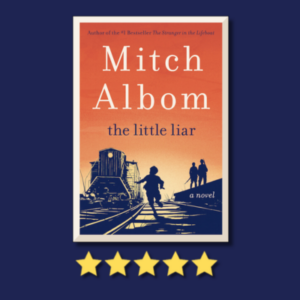
 Published: 2023
Author: Mitch Albom
Genre: Historical Fiction / Holocaust Narrative / Philosophical Parable
Audience: Grades 9–12 (High School) & Adults
Number of Stars: ★★★★☆
Goodreads Link: The Little Liar
Content/Trigger Warnings: Severe anti-Semitism, systemic genocide, graphic wartime violence, infanticide, suicidal ideation, gun violence, and severe physical/emotional abuse.
Review by: Sarah Williams
Publisher’s Summary
Beloved bestselling author Mitch Albom returns with a powerful novel that moves from a coastal Greek city during the Holocaust, to America, where the intertwined lives of three survivors are forever changed by the perils of deception and the grace of redemption.
Eleven-year-old Nico Krispis never told a lie. When the Nazi’s invade his home in Salonika, Greece, the trustworthy boy is discovered by a German officer, who offers him a chance to save his family. All Nico has to do is convince his fellow Jewish residents to board trains heading to “new homes” where they are promised jobs and safety. Unaware that this is all a cruel ruse, the innocent boy goes to the station platform every day and reassures the passengers that the journey is safe. But when the final train is at the station, Nico sees his family being loaded into a large boxcar crowded with other neighbors. Only after it is too late does Nico discover that he helped send the people he loved—and all the others—to their doom at Auschwitz. Nico escapes—but he never tells the truth again.
In The Little Liar, his first novel set during the Holocaust, Mitch Albom interweaves the stories of Nico, his brother Sebastian, and their schoolmate Fanni, who miraculously survive the death camps and spend years searching for Nico, who has become a pathological liar, and the Nazi officer who radically changed their lives. As the decades pass, Albom reveals the consequences of what they said, did, and endured. A moving parable that explores honesty, survival, revenge and devotion, The Little Liar is Mitch Albom at his very best. Narrated by the voice of Truth itself, it is a timeless story about the harm we inflict with our deceits, and the power of love to ultimately redeem us.
Full Review
I am a massive, long-time fan of Mitch Albom’s books, even going so far as to teach Tuesdays with Morrie every single year to my high school seniors. Because of that background, whenever I see a brand-new title released by him, I am incredibly eager to dive right into it.
This particular novel is a work of historical fiction that uniquely chooses to be narrated by the personified entity of Truth itself, tracking the lives of four main characters during the horrors of the Holocaust. I was initially highly intrigued by the first few pages because of this unusual, experimental narrative point of view, watching Truth speak completely directly to the reader.
However, as the broader story unfolded, I actually became much less interested in the actual characters. The author focused so heavily on maintaining this abstract POV that, for me personally, it accidentally took away from the organic momentum of the storyline.
That critique aside, I thoroughly enjoyed the deeply researched historical aspects of this book. It is exceptionally well-written, living up to the high literary standard of many of his other celebrated works. Structurally, it strongly reminded me of two of his other spiritual fiction projects: The Five People You Meet in Heaven and The Stranger in the Lifeboat.
Overall, this is a beautifully written, heavy parable packed with vital historical lessons regarding the profound importance of honesty, human survival, and the absolute lengths we are willing to go to protect the ones we love. While it ultimately wasn’t my absolute favorite of Albom’s vast bibliography—as I find that I generally enjoy his non-fiction works much better than his fiction—it remains a solid, meaningful piece of literature. If you are a fan of historical fiction, Holocaust survivor narratives, or unusual storytelling devices, this book might be an excellent fit for your shelves.
🏛️ The Literary Architecture of Albom’s Parable
Albom utilizes an abstract, omniscient narrator to frame the psychological destruction of a community under Nazi occupation.
- The Weaponization of Innocence: The core tragedy relies on a cruel paradox: the Nazi regime takes the boy’s purest virtue (his inability to lie) and transforms it into a tool for mass extermination. This emphasizes how totalitarian systems twist human goodness into compliance.
- The Abstract Distraction: As the reviewer notes, choosing “Truth” as a literal narrator can create emotional distance. Because an abstract concept doesn’t have flesh, blood, or immediate human stakes, its continuous philosophical interjections can occasionally pull the reader away from the gritty reality of the characters’ survival.
🎒 Classroom & Curricular Connections
- World History & Holocaust Studies (The Destruction of Salonika’s Jewish Community):
- Activity Idea: “The Forgotten History of Sephardic Greece.” Most classroom curriculums focus exclusively on Central and Eastern European Holocaust history. Use Albom’s setting of Salonika (Thessaloniki) to explore the rich history of Sephardic Jews in Greece, who made up a massive portion of the city’s population before 95% of them were systematically deported to Auschwitz. Have students research and map this specific, often-overlooked geographic tragedy.
- English Language Arts & Visual Literacy (Analyzing Abstract Narrators):
- Activity Idea: “Personifying the Intangible.” Compare Albom’s choice to use “Truth” as a narrator with Marcus Zusak’s choice to use “Death” in The Book Thief. Lead a classroom discussion on why historical fiction authors use cosmic, non-human narrators to process massive human tragedies like genocide. Have students write a one-page scene of a historical event narrated by an abstract concept (e.g., Time, Fear, or Justice).