 Published: 2023
Series: N/A
Author: Katherine Marsh
Illustrator: N/A
Genres: Historical Fiction, Middle Grade, Fiction, Young Adult, Ukraine, Family, Realistic Fiction, Childrens
Audience (Grade Levels): 7-12
Number of Stars: ⭐⭐⭐⭐⭐ (5/5 stars)
Goodreads Link: The Lost Year
Triggers: Mass starvation/famine, grief and loss, political oppression, family separation, isolation, and pandemic anxiety
Review By: Monica Morse
Publisher’s Summary:
Thirteen-year-old Matthew is miserable. His journalist dad is stuck overseas indefinitely, and his mom has moved in his one-hundred-year-old great-grandmother to ride out the pandemic, adding to his stress and isolation.
But when Matthew finds a tattered black-and-white photo in his great-grandmother’s belongings, he discovers a clue to a hidden chapter of her past, one that will lead to a life-shattering family secret. Set in alternating timelines that connect the present-day to the 1930s and the US to the USSR, Katherine Marsh’s latest novel sheds fresh light on the Holodomor – the horrific famine that killed millions of Ukrainians, and which the Soviet government covered up for decades.
Review:
Katherine Marsh’s The Lost Year is a deeply moving, impeccably researched historical fiction masterpiece that bridges past and present in a way that will thoroughly captivate middle and high school readers. The story centers around thirteen-year-old Matthew, who is struggling with intense boredom and isolation during the early months of the COVID-19 pandemic. His father, a journalist, is stranded abroad, and his mother has moved his centenarian great-grandmother, GG, into their home. Matthew’s life shifts dramatically when he is tasked with helping clear out GG’s old belongings and stumbles upon a faded, tattered photograph from the 1930s. This artifact unearths a long-buried family secret, transporting the narrative into alternating timelines that connect modern-day America to the harrowing events of the Holodomor—the man-made, Soviet-engineered famine that devastated Ukraine and killed millions of people under Stalin’s regime, a atrocity obscured by decades of government cover-ups.
With loving historical fiction books, this book was easy to dive into. Katherine Marsh sets up the characters and plot to help you fall in love with the story. With this story using the COVID pandemic as a reason for the plot, it is easy to relate to the story and to understand what Matthew is going through. I can see many of our high school students being able to relate with Matthew. The parallel between Matthew’s pandemic isolation and the structural confinement of the historical timelines creates an immediate emotional connection. With the historical story about the US and USSR, I couldn’t help but to stop and think about what is going on today with Ukraine and Russia. With the present day events and this story being written during the pandemic, it is one that will sit with me for months to come. Having read many Alan Gratz books, the structure of this book was easy for me to follow. However, others may struggle with the two different timelines.
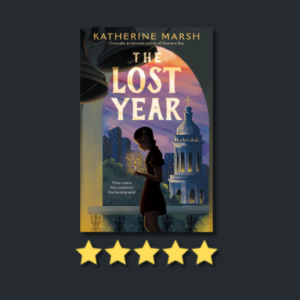
Marsh’s evocative prose and masterful organization allow the two eras to converse beautifully with one another, highlighting themes of truth, journalistic integrity, and generational resilience. The cover art is incredibly striking and will easily attract the eyes of target middle and high school students browsing library shelves. I give this book a well-deserved 5 stars and strongly recommend it to fellow educators, school librarians, and history buffs. It stands out as an irreplaceable resource for fostering historical literacy and empathy in adolescents, rendering it a high-value addition to secondary library collections.
Classroom & Curricular Connections:
- Social Studies / World History: This novel serves as an excellent curriculum link for studying European history, the USSR under Joseph Stalin, the mechanics of state-sponsored propaganda, and the historical context of the Holodomor in Ukraine.
- ELA / Literary Analysis: An outstanding mentor text for exploring multi-perspective storytelling, dual-timeline structures, intergenerational narratives, and character foils.
- Extension Activity / Library Application: This book is ideally suited for school literature circles, independent reading selections, or a combined ELA and history book club. As an extension activity, students can examine primary sources from the 1930s regarding the Soviet famine—including the conflicting reporting of journalists like Walter Duranty and Gareth Jones—and write a reflective essay on the vital role of ethical journalism in preserving truth.
- Diversity & Representation: The book offers exceptional representation by bringing to light the historically underrepresented experiences of Ukrainian families during the Holodomor. It treats the concepts of cultural trauma, immigration, survival, and the preservation of hidden heritage with immense authenticity and care, honoring Marsh’s own family history.
Readalikes:
- Enemies in the Orchard by Dana Vanderlugt
- When the World Was Ours by Liz Kessler
- The Blackbird Girls by Anne Blankman
- The Partition Project by Saadia Faruqi
- Each and Every Spark by Claire Swinarski
- Safiyyah’s War by Hiba Noor Khan