 Published: 2022
Series: N/A
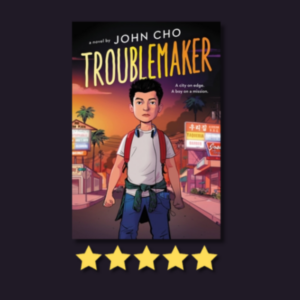
Author: John Cho
Illustrator: N/A
Genres: Historical Fiction, Asian American, Middle Grade, Fiction, Young Adult, Family, Realistic Fiction, Childrens, Asian Literature
Audience (Grade Levels): Grades 4-7
Number of Stars: ⭐⭐⭐⭐⭐ (5/5 stars)
Goodreads Link: Troublemaker
Triggers: Civil unrest, systemic racism, racial violence, police brutality references (Rodney King acquittal), gun violence reference (Latasha Harlins shooting)
Review By: Kim LeRoy
Publisher’s Summary:
12-year-old Jordan feels like he can’t live up to the example his older sister set, or his parent’s expectations. When he returns home from school one day hoping to hide his suspension, Los Angeles has reached a turning point. In the wake of the acquittal of the police officers filmed beating Rodney King, as well as the shooting of a young black teen, Latasha Harlins, by a Korean store owner, the country is at the precipice of confronting its racist past and present.
As tensions escalate, Jordan’s father leaves to check on the family store, spurring Jordan and his friends to embark on a dangerous journey to come to his aide, and come to terms with the racism within and affecting their community.
Review:
In Troublemaker by John Cho, readers are transported to a pivotal moment in American history through the eyes of twelve-year-old Jordan Park. Set during the 1992 Los Angeles Riots, this middle-grade historical fiction novel stands out as an exceptional selection for upper elementary and middle school readers across grades 4 to 8. The narrative kicks off on the day Los Angeles erupts following the acquittal of the police officers who beat Rodney King, compounded by neighborhood grief over the tragic shooting of Latasha Harlins. Jordan, desperate to hide a recent school suspension from his high-achieving family, finds himself caught up in the historic unrest when his father leaves to protect their family store in South Central. Driven by a fierce desire to help and prove his worth, Jordan and his friends journey across a city on fire, forcing him to confront both the external chaos and internal biases within his community.
Cho’s writing style is remarkably clear and accessible, utilizing straightforward language that perfectly translates complex social issues and historical weight for younger readers. The fast-moving pacing successfully mirrors the real-time urgency and tension of the riots. Jordan’s emotional and psychological growth serves as the novel’s core strength; he matures beautifully from a self-absorbed boy trying to escape his mistakes into a deeply reflective young man grappling with systemic racism, cultural misunderstandings, and family dynamics. While a minor limitation is that some secondary characters could have benefited from deeper development, it does not detract from Jordan’s compelling personal arc.
I highly recommend this 5-star book to fellow educators and school librarians looking for narratives that build empathy and historical literacy. The story tackles profound social-emotional learning themes like accountability, intersectional prejudice, and community resilience with immense sensitivity. It offers an invaluable, authentic window into the Korean American perspective during a historical crisis without offering easy answers. This is a must-have addition for literature circles, independent reading programs, and school library collections alike.
Classroom & Curricular Connections:
- Social Studies / ELA: This book connects seamlessly to modern US History curriculum focusing on civil rights, urban history, and the 1992 LA Riots. In ELA, it serves as an excellent mentor text for exploring perspective-taking, historical fiction conventions, and character development arcs.
- Extension Activity / Library Application: Perfect for a middle school book club, literature circle, or read-aloud program. Students can pair their reading with a media literacy activity analyzing primary sources—such as archival news broadcasts, photographs, and print articles from April 1992—to evaluate how historical fiction captures real-world events.
- Diversity & Representation Note: The text brilliantly supports diversity, equity, and inclusion by offering a nuanced, deeply authentic portrayal of a Korean American family caught in a cross-cultural historical crisis. It addresses intersectional prejudice and complex community dynamics with immense honesty and cultural depth.
Readalikes:
- Falling Short by Ernesto Cisneros
- Attack of the Black Rectangles by Amy Sarig King
- Iveliz Explains It All by Andrea Beatriz Arango