 Published: 2022
Series: N/A
Author: Meghan McCarthy
Illustrator: Meghan McCarthy
Genres: Picture Books, Nonfiction, History, Historical, Childrens, Art, Juvenile, American History, Media Tie In, Middle Grade
Audience (Grade Levels): Upper-Elementary (Grades 5-6)
Number of Stars: ⭐⭐⭐⭐⭐
Goodreads Link: Action! How Movies Began
Triggers: None
Review By: Jacqueline Wolken
Publisher’s Summary:
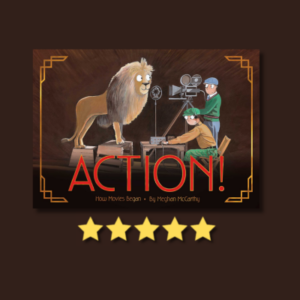
Award-winning nonfiction picture book creator Meghan McCarthy tells the story of how motion pictures came to be invented and the story of the many people who helped create them. Movies take us on adventures, introduce us to new worlds, and make us feel, but how did they start? In her trademark easy-to-follow narrative voice, this fact-filled picture book tells the story of the evolution of movies and the people who worked hard to create them—both on-screen and behind the scenes. In fascinating detail, she shows how early photography capturing motion became silent films, which led to the first color films (like the beloved Wizard of Oz), and how those building blocks allowed for the inspiring movies of today.
Review:
For students who love to learn about history, technology, or just interesting facts, this book is a treasure trove. It takes the reader through the history of photography and filmography from the 1800’s to modern times. I would recommend this text for students who are interested in the topic or who are completing research projects about filmography, but not necessarily as a classroom read aloud. The text is long and informative, but might not appeal to an entire class of students.There are many familiar movies, such as Star Wars and Black Panther, mentioned, as well as many films from the early 1900’s. The illustrations help to draw connections between movies of the past and present, discussing the influence of earlier films on today’s movies.
Classroom & Curricular Connections:
- Social Studies & American History: This book serves as a fantastic resource for studying the industrial era, technological advancements from the 1800s onward, and the cultural evolution of American entertainment over the past two centuries.
- Art & Media Literacy: Highly applicable for units analyzing visual media, media literacy, design, and the foundational building blocks of photography, filmography, and theatrical arts.
- English Language Arts (ELA): A strong mentor text for upper-elementary informational reading, teaching students how to track chronologically sequenced history and extract facts from long-form nonfiction narrative styles.
- Extension Activity / Library Application:
- Independent Research & STEM Projects: Ideal for students working on independent research or specialized passion projects focused on the evolution of technology, early inventions, or cinema history.
- “Past to Present” Media Display: Librarians can pair this text with an interactive display featuring older film concepts alongside modern pop-culture cornerstones mentioned in the book, like Star Wars and Black Panther, to visually link classic and contemporary media.
- Diversity & Representation: This informative volume supports inclusive representation by exploring the broad history of cinema “both on-screen and behind the scenes,” highlighting the collective group of diverse historical figures whose foundational hard work made modern cinema possible. By acknowledging milestone films across different cinematic eras, it provides young readers with a broader, more globally connected perspective on how modern diverse landmarks are deeply influenced by early storytelling structures.
Readalikes:
- Pop! The Invention of Bubble Gum by Meghan McCarthy
- Balderdash!: John Newbery and the Story of the Book that Changed Children’s Books by Michelle Markel