 Published: 2022
Series: N/A
Author: Costantia Manoli
Illustrator: Magdalena Mora
Genres: Picture Books, Friendship, Food, Immigration, School, Childrens, Fiction, Realistic Fiction, Family, Cultural
Audience (Grade Levels): Elementary
Number of Stars: ⭐⭐⭐⭐⭐
Goodreads Link: Tomatoes in My Lunchbox
Triggers: Culturally-Diverse Names
Review By: Jacqueline Wolken
Publisher’s Summary:
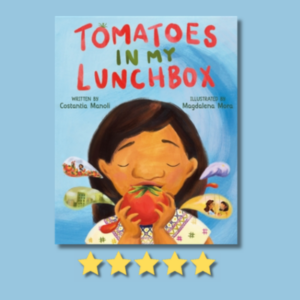
A moving picture book from a debut author about the first day of school, layered with themes about the immigrant experience and the universal experience of feeling out of place.
child, newly arrived in another country, feels displaced, lonely, and a little scared on her first day of school. Her name doesn’t sound the way she’s used to hearing it. She knows she doesn’t fit in. And when she eats her whole tomato for lunch, she can feel her classmates observing her—and not quite understanding her. But sometimes all it takes is one friend, one connection, to bring two worlds together, and gradually the girl, her tomato, and her full name, start to feel at home with her new friends and community. This emotionally sweeping debut picture book by Costantia Manoli, with vibrant art by Magdalena Mora, artfully captures feelings of displacement and the joy that comes from forging new friendships.
Review:
The narrator in this story is a little girl, new to this country, who feels that she doesn’t fit in. She feels that her culturally-diverse name and lunch meal makes her stand apart from the other kids. She eats tomatoes whole and doesn’t have a common name like Emma or Olivia. What I love about this text is the discussion about how our names make us feel. The narrator says that when her mother says her name, “it’s soft like summer”, but when her teacher mispronounces her name, it’s “strange and sharp, and sounds like something is breaking”. Everyone’s name is an important part of their identity, and this story helps us to understand how it makes someone feel when their name is constantly mispronounced. For someone who comes from a different culture than many of their peers, the way their name is spoken (or misspoken), carries a weight that could be hard to recognize for others. The message in this story is about diversity, the importance of individuality, as well as the power of acceptance and inclusion. A beautifully told story!
Classroom & Curricular Connections:
- Social-Emotional Learning (SEL): This book is an essential resource for teaching children about empathy, the universal experience of feeling out of place, and the immense emotional weight behind the correct pronunciation of our names. It serves as a great tool for starting the school year by establishing inclusion and community within the classroom.
- Social Studies & Human Geography: This narrative fits beautifully into units concerning immigration, global movement, and cultural diversity. It allows younger students to examine how daily routines, like lunch, vary across different world cultures.
- English Language Arts (ELA): Ideal for modeling sensory language and descriptive metaphors, particularly when examining how the text compares the emotional tone of a name spoken at home versus in a new environment.
- Extension Activity / Library Application:
- Interactive First-Week Read-Aloud: Librarians and teachers can feature this title as a read-aloud to introduce classroom name-learning games. Students can share the origin, meaning, or stories behind their own names to encourage pride in individual identities.
- Cultural Lunchbox Show-and-Tell / Art Activity: Pair this book with a creative drawing project where students design their own perfect lunchboxes, integrating foods that reflect their familial or cultural backgrounds to celebrate unique foods and diversity.
- Diversity & Representation: This title beautifully highlights diversity, equity, and inclusion by portraying the realistic emotional landscape of a young immigrant adjusting to an unfamiliar culture. By centering on the concept of identity linked to diverse names and cultural food choices, Manoli provides a powerful mirror for first-generation students and an eye-opening window for others, encouraging total acceptance over assimilation.
Readalikes:
- Your Name Is a Song by Jamilah Thompkins-Bigelow
- The Name Jar by Yangsook Choi