 Published: 2021
Series: N/A
Author / Editor: Dahlia Adler
Illustrator: N/A
Genres: Short Stories, Young Adult, Retellings, Anthologies, Fiction, Shakespeare, Contemporary, LGBT, Romance, Queer
Audience (Grade Levels): Grades 9-10, 11-12
Number of Stars: ⭐⭐⭐⭐⭐
Goodreads Link: That Way Madness Lies
Triggers / Content Warnings: Death, antisemitism, medical content/miscarriage, car accident, blood, mental health issues
Review By: Sarah Williams
Publisher’s Summary:
Fifteen acclaimed YA writers put their modern spin on William Shakespeare’s celebrated classics!
West Side Story. 10 Things I Hate About You. Kiss Me, Kate. Contemporary audiences have always craved reimaginings of Shakespeare’s most beloved works. Now, some of today’s best writers for teens take on the Bard in these 15 whip-smart and original retellings!
Contributors include Dahlia Adler (reimagining The Merchant of Venice), Kayla Ancrum (The Taming of the Shrew), Lily Anderson (As You Like It), Patrice Caldwell (Hamlet), Melissa Bashardoust (A Winter’s Tale), Amy Rose Capetta and Cori McCarthy (Much Ado About Nothing), Brittany Cavallaro (Sonnet 147), Joy McCullough (King Lear), Anna-Marie McLemore (A Midsummer Night’s Dream), Samantha Mabry (Macbeth), Tochi Onyebuchi (Coriolanus), Mark Oshiro (Twelfth Night), Lindsay Smith (Julius Caesar), Kiersten White (Romeo and Juliet), and Emily Wibberley and Austin Siegemund-Broka (The Tempest).
Original Review:
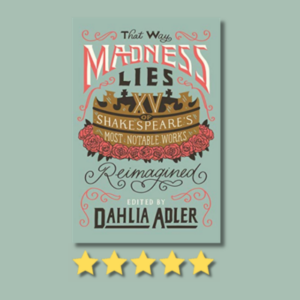
That Way Madness Lies, edited by Dahlia Adler, is a thought-provoking and diverse anthology of young adult retellings of Shakespearean works. I was drawn to this collection because it features a wide range of adaptations on the Bard´s works, making it a compelling read for this fan of Shakespeare. What sets this anthology apart is its emphasis on exploring mental health issues through the lens of Shakespearean stories. Each author tackles these themes in a unique way, offering fresh perspectives on well-known tales. From anxiety and depression to identity and self-discovery, the stories in That Way Madness Lies cover a wide array of mental health topics. The exploration of mental health in young adult literature is both timely and necessary, and That Way Madness Lies does a good job of addressing this important topic. It’s not just a collection of retellings but also a tool for fostering discussions on mental health and the enduring relevance of Shakespeare’s themes.
The diversity in the anthology is also a strong point, something I appreciated as both a teacher of LGBTQ+ students and a parent of a teen with friends who are still figuring out their identities. The collection incorporates LGBTQ+ representation, as well as various cultural backgrounds, ensuring that many readers will find relatable and inclusive narratives. This diverse range of voices adds depth to the stories and enhances the overall reading experience. Some stories stood out to me as exceptional in their storytelling and character development, while others may not have resonated as strongly. I was particularly drawn to Kiersten White’s “Partying Is Such Sweet Sorrow” which recounts the plot of Romeo and Juliet through text message. Overall, teens, the intended audience, will appreciate the stories more if they know the plots of the original plays, but they can enjoy the stories without this context. The writing quality throughout the anthology is consistently strong, with each author bringing their unique style and perspective to the stories.
This book is a stellar resource for high school educators and school librarians looking to bridge historical drama with contemporary issues. The narrative pacing varies naturally between text-message layouts, prose, and speculative formats, which prevents the anthology from feeling stagnant. The cover design effectively appeals to teens with its moody, artistic, and modern aesthetic, signaling that this is not their standard school-assigned Shakespeare. While a few structural transitions between tales feel abrupt due to the varying styles of fifteen distinct authors, the overall cohesion remains remarkably intact. It is a vital and high-value addition to independent high school reading spaces and elective creative writing shelves.
Classroom & Curricular Connections:
- ELA (English Language Arts): An unparalleled tool for a comparative literature unit. Students can read an original Shakespearean scene and analyze how modern authors change the syntax, medium (such as text messaging), and character motivations to fit modern YA sensibilities.
- Social Studies / History: Use the historical contexts of the original plays to analyze how societal norms around gender roles, mental health, and minoritized groups have evolved into the 21st century.
- SEL (Social-Emotional Learning): Serves as an exceptional platform for discussing adolescent mental health, anxiety, coping mechanisms, and identity reclamation.
- Extension Activity / Library Application: Perfect for a high school literature circle or library book club. Run a “Modern Monologue Media Challenge” where students take a classic monologue from a play not featured in the collection (like Othello or Henry V) and translate it into a modern digital medium—such as a series of text messages, a social media thread, or a modern script snippet.
- Diversity & Representation: For stories modeled after 500-year-old frameworks, this anthology works wonders with representation. It seamlessly integrates characters who are not just white men or weak women, providing essential cultural diversity and validating LGBTQ+ representation for teens who are actively navigating their own identities.