 Published: 2021
Series: N/A
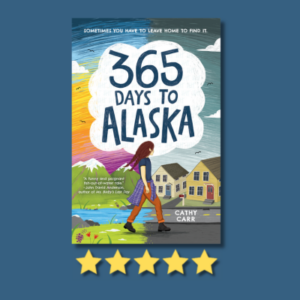
Author: Cathy Carr
Illustrator: N/A
Genres: Middle Grade, Realistic Fiction, Contemporary, Divorce, Family, Juvenile, Animals, Fiction, Coming Of Age
Audience (Grade Levels): Middle School; 5-8
Number of Stars: ⭐⭐⭐⭐⭐
Goodreads Link: 365 Days to Alaska
Triggers / Content Warnings: Parental divorce, family separation, emotional abandonment/neglect by a parent.
Review By: Corinne Blair
Publisher’s Summary:
A thoughtful middle-grade debut about a girl from off-the-grid Alaska adjusting to suburban life
Eleven-year-old Rigel Harman loves her life in off-the-grid Alaska. She hunts rabbits, takes correspondence classes through the mail, and plays dominoes with her family in their two-room cabin. She doesn’t mind not having electricity or running water—instead, she’s got tall trees, fresh streams, and endless sky.
But then her parents divorce, and Rigel and her sisters have to move with their mom to the Connecticut suburbs to live with a grandmother they’ve never met. Rigel hates it in Connecticut. It’s noisy, and crowded, and there’s no real nature. Her only hope is a secret pact that she made with her father: If she can stick it out in Connecticut for one year, he’ll bring her back home.
At first, surviving the year feels impossible. Middle school is nothing like the wilderness, and she doesn’t connect with anyone . . . until she befriends a crow living behind her school. And if this wild creature has made a life for itself in the suburbs, then, just maybe, Rigel can too.
365 Days to Alaska is a wise and funny debut novel about finding beauty, hope, and connection in the world no matter where you are—even Connecticut.
Review:
365 Days to Alaska is a beautiful story that I truly loved. I am fascinated by stories set in Alaska and the Arctic so I was excited to read this author’s debut novel. I think the author did a wonderful job of talking about such delicate topics in a realistic way. Divorce is a main topic in this book it it really shows the struggle Rigel goes through not only leaving her life in Alaska but leaving behind her dad, who she is very close to. She struggles with keeping in touch with him as his communication becomes less and less and ultimately stops. It was heartbreaking but realistic. I loved the characters as Rigel has two sisters who are very different from her. Rigel’s grandmother is a beautiful character as well. I enjoyed the parts of the book where Rigel was interacting with the crow she found, Blueberry. Blueberry taught Rigel so much about herself and life in general.
Classroom & Curricular Connections:
- ELA (English Language Arts): A phenomenal choice for intermediate literature circles focusing on character development, internal versus external conflict, and examining how symbolic motifs (such as Blueberry the crow) mirror a protagonist’s emotional evolution.
- Social Studies & Human Geography: Pairs perfectly with units exploring regional geography and cultural lifestyle contrasts within the United States, encouraging students to compare off-the-grid subsistence living with modern suburban infrastructure.
- SEL (Social-Emotional Learning): Provides vital, healthy pathways for discussing the heavy emotional toll of parental separation, navigating changing family structures, coping with emotional abandonment, and cultivating self-soothing behaviors during major life disruptions.
- Extension Activity / Library Application: Ideal for middle school library programming or independent study choiceboards. Librarians can coordinate a “Local Wildlife and Resilience Observation Journal.” Mirroring Rigel’s transformative relationship with Blueberry, students can spend a week observing a specific urban or suburban animal species near their school or home, documenting the survival adaptations the creature uses to thrive in a human-built environment.
- Diversity & Representation: The book models exceptional emotional diversity, equity, and inclusion by providing a nuanced and deeply empathetic look at non-traditional, fractured family dynamics. By showcasing a variety of coping mechanisms across three structurally distinct sisters and highlighting the profound value of intergenerational support through the grandmother, Carr validates the messy, varied, and non-linear paths of grieving children without resorting to tidy clichés or forced resolutions.