 Published: 2020
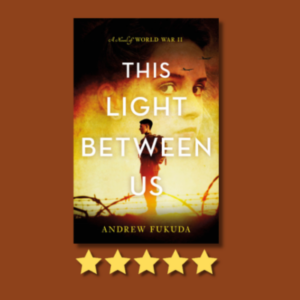
Author: Andrew Fukuda
Genres: Historical Fiction, Young Adult, World War II, Fiction, War, Holocaust, Friendship, Asian Voices
Audience (Grade Levels): Teen / Grades 7-12
Number of Stars: ⭐⭐⭐⭐⭐ (5/5 Stars)
Goodreads Link: This Light Between Us
Triggers: Death, Holocaust, Japanese incarceration camps, racism
Review By: Kendra Napierala-Myers
Publisher’s Summary:
A story of World War II about the unlikeliest of pen pals–a Japanese American boy and a French Jewish girl–as they fight to maintain hope in a time of war.
In 1935, ten-year-old Alex Maki from Bainbridge Island, Washington is disgusted when he’s forced to become pen pals with Charlie Levy of Paris, France–a girl. He thought she was a boy. In spite of Alex’s reluctance, their letters continue to fly across the Atlantic–and along with them the shared hopes and dreams of friendship. Until the Japanese attack on Pearl Harbor and the growing Nazi persecution of Jews force them to confront the darkest aspects of human nature.
From the desolation of an internment camp on the plains of Manzanar to the horrors of Auschwitz and the devastation of European battlefields, the only thing they can hold onto are the memories of their letters. But nothing can dispel the light between them.
Review:
This Light Between Us by Andrew Fukuda does not disappoint. It is easy to see why it is an award winner and would be appropriate for any students 7-12 grade. Told from the perspective of lanky, sometimes awkward Alex Maki, the story contrasts life as an Asian American after Pearl Harbor to Charlie, a young, Jewish, Parisian girl. The story walks us through the frustrations of the Japanese American internment camps, along with the impossible decisions that Japanese families had to make at the time. It highlights the heroism of the 442nd Regimental Combat Team, all while paying tribute to the loss and inhumaneness of the Holocaust.
The incorporation of Charlie and Alex’s infatuation with her is a great juxtaposition of the massive loss during the Holocaust to the incarceration of Japanese Americans at the time. Alex and Charlie become pen pals when they are only 10 years old. We get to know them through the letters that they write to each other and we get to see how things are changing in both of their worlds. Charlie does play a part in this book, but I really feel like this was Alex’s story. The descriptions of what Alex and his family went through in the internment camps were heartbreaking.
Alex’s decision to join the military in the hopes of helping his father really demonstrated the strength of his character. The descriptions of the battles that Alex’s unit faced were incredibly vivid. I felt like I was right there with Alex, Mutt, Teddy, and the rest of their unit as they faced nearly impossible odds. Alex played a very important part in his unit and was under a lot of pressure, but he handled it like a pro. He never stopped thinking about his family or Charlie even when things were at their worst. I would highly recommend this book to others. It was an emotional read and beautiful at the same time.
Classroom & Curricular Connections:
- US & World History (WWII): Provides an exceptional parallel study of the home front and the European theater, examining Executive Order 9066, the forced relocation of citizens to camps like Manzanar, and the realities of the Holocaust in occupied France.
- Military History: Highlights the historical legacy and immense heroism of the 442nd Regimental Combat Team—an army unit composed almost entirely of second-generation Japanese American soldiers (Nisei) who fought valiantly in Europe while their families remained incarcerated back home.
- Language Arts / Epistolary Analysis: Excellent for examining how authors use letters and epistolary elements to establish deep cross-continental character bonds, track parallel timelines, and build emotional tension over a decade of historical upheaval.
Extension Activity / Library Application:
- Fiction & Nonfiction Historical Pairing: Pair This Light Between Us with graphic memoirs or nonfiction texts such as George Takei’s They Called Us Enemy or Laura Hillenbrand’s Unbroken. Have students work in groups to curate a comparative timeline, matching Alex’s fictional journey against primary sources, historical photographs, and real-world accounts of Bainbridge Island and Manzanar.
- “Voices Across the Atlantic” Epistolary Writing: Prompt students to select a specific historical turning point featured in the novel (e.g., the immediate aftermath of Pearl Harbor or the implementation of anti-Semitic laws in Paris). Have them draft a missing letter between Alex and Charlie using historical context clues to demonstrate how international correspondence preserves human empathy during global crises.
Diversity & Representation Note:
Winner of the Asian/Pacific American Award for Literature, this book brings vital intersectional equity and representation to WWII literature. By juxtaposing the systematic oppression of a Jewish youth in Europe with the unjust incarceration of a Japanese American citizen at home, Fukuda masterfully explores the nuances of identity, prejudice, and patriotism. It offers a powerful, humanizing window into what it meant to fight for America when America turned its back on you.
Readalikes:
- We Are Not Free by Traci Chee
- The Book Thief by Markus Zusak
- Paper Wishes by Lois Sepahban