 Published: 2022
Series: The Book of Tea
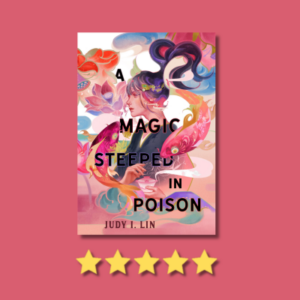
Author: Judy I. Lin
Genres: Fantasy, Young Adult, Fiction, Romance, Mythology, Young Adult Fantasy, Magic, Historical Fiction, Historical
Audience (Grade Levels): Young Adult, 7-9
Number of Stars: 5 Stars
Goodreads Link: A Magic Steeped in Poison
Triggers: Language, violence, sexual content
Review By: Sara Kahrs
Publisher’s Summary:
For Ning, the only thing worse than losing her mother is knowing that it’s her own fault. She was the one who unknowingly brewed the poison tea that killed her—the poison tea that now threatens to also take her sister, Shu. When Ning hears of a competition to find the kingdom’s greatest shennong-shi—masters of the ancient and magical art of tea-making—she travels to the imperial city to compete. The winner will receive a favor from the princess, which may be Ning’s only chance to save her sister’s life. But between the backstabbing competitors, bloody court politics, and a mysterious (and handsome) boy with a shocking secret, Ning might actually be the one in more danger.
Review:
A Magic Steeped in Poison is a unique story that kept me interested the whole time. Lin was inspired by the belief in many Asia cultures that tea has healing/magical properties. I learned more about tea appreciated the glimpse into this intricate belief. In the case of her book, tea is truly magical which adds an element of fantasy that is both whimsical and dangerous. She also uses the idea that magic pulls from the user’s energy, which is a common belief in many cultures. Her main character, Ning is naive but tries hard to change that. She is analytical and resilient which makes you want to root for her. Even though some things were predictable, there were surprises that took the story in a direction I could not predict. Ultimately, this was a fun read that I recommend to anyone who loves fantasy.
Classroom & Curricular Connections:
- Social Studies / World Cultures: This text serves as a brilliant cultural window into Asian traditions, mythology, and the profound historical belief that tea possesses healing and medicinal properties. Educators can leverage the book to explore how cultural values, folklore, and intricate rituals are translated into fantasy world-building.
- English Language Arts / Creative Writing: The novel introduces a unique, sensory-based magic system centered on the art of tea-making (shennong-shi). Teachers can use this to analyze alternative magic mechanics, particularly the cross-cultural narrative trope that using magic expends and pulls directly from a character’s physical energy.
- Social-Emotional Learning (SEL): The story charts the growth of an analytical, resilient protagonist who overcomes naivety and handles high-stakes pressure to save her family. It provides strong discussion points regarding grief, personal accountability, resilience, and inner strength under duress.
Diversity & Representation:
-
The novel strongly highlights diversity, equity, and inclusion by centering on authentic Asian voices and cultural traditions, heavily drawing from traditional East Asian folklore and customs. By featuring a strong, capable, and multi-layered Asian heroine, the text provides vital representation, enriching school collections by exploring complex political landscapes and cultural dynamics through an inclusive fantasy lens.
Readalikes:
- A Venoms Dark and Sweet (The Book of Tea #2) by Judy I. Lin
- Spin the Dawn by Elizabeth Lim
- Iron Widow by Xiran Jay Zhao