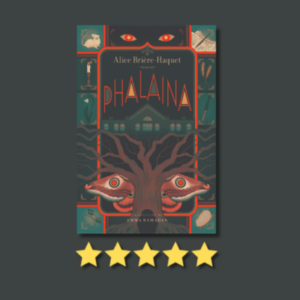
 Published: 2022
Author: Alice Brière-Haquet
Translator: Emma Ramadan
Illustrator/Cover Artist: Allissa Chan
Genres: Fantasy, Young Adult, Science Fiction, Horror, Historical Fiction, Middle Grade, Fiction, Historical, Magical Realism, Mystery, Thriller
Audience (Grade Levels): Middle Grade, 7-8
Number of Stars: 3 Stars
Goodreads Link: Phalaina
Triggers: Orphans, violence, mysterious/violent deaths, bleak and suspenseful themes
Review By: Deb McHugh
Publisher’s Summary:
We discover a new species of life form every day. But, every day, a species also disappears. The fly has 10 chromosomes, the hamster 22, the rat 42, the human 46, the chimpanzee 48, the cow 60, and the butterfly 380.
London, 1881.
There’s something a little eerie about Manon – she’s not like the other girls at the orphanage. Maybe it’s her red eyes. Maybe it’s her silence. Maybe it’s the series of violent deaths that seem to follow her. What we do know: someone is hot on her tail. And there’s a lot of money at stake in finding out where exactly she comes from – and what exactly she is.
Concurrent to Manon’s story are letters to Charles Darwin from Professor Humphrey, a scientist who has recently died under mysterious circumstances. Is it true that natural selection left humans at the top of the pyramid of life after all? Or in the process of evolution, was there something elemental that humans lost, something that connected us to the rest of life on earth? Who and what else is out there? In order to stay alive, Manon must untangle the mystery of her origins, and perhaps the origins of humanity as well. From French writer Alice Brière-Haquet and translated by PEN-award winning translator Emma Ramadan comes PHALAINA – the middle grade historical sci-fi thriller you won’t be able to put down.
Review:
I bought this book because I loved the cover art done by Allissa Chan but I found this book to be a brutal commentary on man and although it is written for middle grade students, I’m not sure they would understand nor enjoy the story. The tone of the story is bleak and suspenseful. Manon’s age is uncertain but she doesn’t speak, eat animal products, and is afraid of fire. There are forces of good and evil and it isn’t always clear which side Manon is on. The story is told in short chapters with vivid descriptions. Phalaina is a birch moth and it is Greek meaning “the night butterfly.” “Selection has become cultural. It is no less merciless,” written to Charles Darwin by Professor Humphrey (p. 179).
Classroom & Curricular Connections:
- Science / Biology (Evolution & Genetics): This book connects directly to evolutionary science, natural selection, and genetic complexity. With direct ties to Charles Darwin and comparative chromosomal data (e.g., matching the human’s 46 chromosomes against a butterfly’s 380), the text can serve as an imaginative springboard for discussing evolutionary biology and what defines a species.
- Social Studies / History (Victorian London & Industrialization): Set in London in 1881, the book provides a atmospheric backdrop for studying the late Victorian era. Teachers can use the stark orphanage environment and the philosophical commentary on “cultural selection” to discuss the era’s rigid societal structures, the ethics of Victorian science, and the human cost of rapid industrial development.
Readalikes:
- Fever Crumb by Philip Reeve
- Anatomy: A Love Story by Dana Schwartz
- Splinter of Scarlet by Emily Bain Murphy