 Published: 2021
Author: Pip Williams
Genres: Historical Fiction, Fiction, Book Club, Historical, Feminism, Romance, British Literature
Audience (Grade Levels): Grades 11-12
Number of Stars: 4 Stars
Goodreads Link: The Dictionary of Lost Words
Triggers: Death of loved ones, physical discipline of children, forced adoption, war/trench warfare
Review By: Sarah Williams
Publisher’s Summary:
In 1901, the word ‘Bondmaid’ was discovered missing from the Oxford English Dictionary. This is the story of the girl who stole it.
Esme is born into a world of words. Motherless and irrepressibly curious, she spends her childhood in the ‘Scriptorium’, a garden shed in Oxford where her father and a team of dedicated lexicographers are collecting words for the very first Oxford English Dictionary. Esme’s place is beneath the sorting table, unseen and unheard. One day a slip of paper containing the word ‘bondmaid’ flutters to the floor. Esme rescues the slip and stashes it in an old wooden case that belongs to her friend, Lizzie, a young servant in the big house. Esme begins to collect other words from the Scriptorium that are misplaced, discarded or have been neglected by the dictionary men. They help her make sense of the world.
Over time, Esme realises that some words are considered more important than others, and that words and meanings relating to women’s experiences often go unrecorded. While she dedicates her life to the Oxford English Dictionary, secretly, she begins to collect words for another dictionary: The Dictionary of Lost Words.
Set when the women’s suffrage movement was at its height and the Great War loomed, The Dictionary of Lost Words reveals a lost narrative, hidden between the lines of a history written by men. It’s a delightful, lyrical and deeply thought-provoking celebration of words, and the power of language to shape the world and our experience of it.
Review:
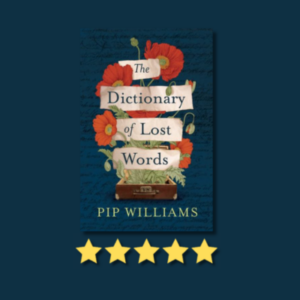
I purchased this book for two reasons. One was the cover, which I found intriguing. The other was the topic central to the story, the creation of the Oxford English Dictionary. I was immediately drawn into the narrative by the lovely prose, but sadly that interest did not last.
The Dictionary of Lost Words is an engaging historical fiction novel that tells the story of a young girl named Esme, who grows up in the Oxford English Dictionary office during the early 20th century. In the book, Williams explores the creation of the OED, as well as the power of language and its ability to shape our understanding of the world.
Positives: Williams’s writing style is beautiful and captivating, immersing the reader in the world of the dictionary office and the characters who inhabit it. The story is well-researched, and the historical details are brought to life in a way that makes them feel both authentic and accessible. The characters are richly drawn, and Esme is a compelling protagonist who undergoes a fascinating journey of self-discovery throughout the novel. I enjoyed reading about a woman who took her own fate into her hands at a time when that was not normal.
Negatives: After the opening chapters the pacing of the novel slows down, and the storyline begins to meander as a result. Some of the characters, particularly the male ones, feel underdeveloped, and their motivations and actions can be difficult to understand. I found myself putting the book down and choosing other texts to read and really had to force myself to finish.
Overall this book had my attention enough for me to complete it. It is thought-provoking and has beautifully written parts. It explores the roots of language, the concept of identity, and the consequences of power. It is a historical fiction text, one that I did learn from.
Classroom & Curricular Connections:
- English Language Arts / Linguistics (Lexicography & Power of Language): This novel offers a brilliant foundation for exploring how dictionaries are constructed, how words get validated, and how language acts as a tool of systemic power. Students can examine the physical and intellectual history of the early Oxford English Dictionary, evaluating how omissions (like the word “bondmaid”) shape or limit public consciousness.
- World History / Women’s Studies (The Suffrage Movement & WWI): Set against the backdrop of the early 20th century, this text mirrors the height of the women’s suffrage movement and the devastating impact of the Great War. It provides a domestic and intellectual perspective on how women claimed self-determination, entered structural career paths, and coped with societal shifts during a time of global warfare.
Readalikes:
- The Liar’s Dictionary by Eley Williams
- The Professor and the Madman by Simon Winchester
- The Book of Longings by Sue Monk Kidd