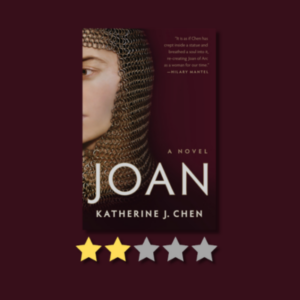
 Published: 2022
Author: Katherine J. Chen
Genres: Historical Fiction, Fiction, Historical, France, Feminism, Medieval, Retellings, War
Audience (Grade Levels): High School / Adult; Grades 10-12+
Number of Stars: 2-Stars
Goodreads Link: Joan
Triggers: Domestic abuse, violence, war-related trauma
Review By: Gina Iorio
Publisher’s Summary:
“Girl. Warrior. Heretic. Saint? A stunning secular reimagining of the epic life of Joan of Arc, in the bold tradition of Hilary Mantel’s Wolf Hall. France is mired in a losing war against England. Its people are starving. Its king is in hiding. From this chaos emerges a teenage girl who will turn the tide of battle and lead the French to victory, an unlikely hero whose name will echo across the centuries.
In Katherine J. Chen’s hands, the myth and legend of Joan of Arc is transformed into a flesh-and-blood young woman: reckless, steel-willed, and brilliant. This deeply researched novel is a sweeping narrative of her life, from a childhood steeped in both joy and violence to her meteoric rise to fame at the head of the French army, where she navigates both the perils of the battlefield and the equally treacherous politics of the royal court. Many are threatened by a woman who leads, and Joan draws wrath and suspicion from all corners, even as her first taste of fame and glory leave her vulnerable to her own powerful ambition. With unforgettably vivid characters, transporting settings, and action-packed storytelling, Joan is a thrilling epic, a triumph of historical fiction, as well as a feminist celebration of one remarkable—and remarkably real—woman who left an indelible mark on history”.
Review:
Jehanne la Pucelle, as she is known in France, is an interesting historical figure. She was urged by “voices” to take up arms and drive the English out of France. The historical record is well documented with eyewitness accounts on every aspect of her life. However, Ms. Chen took the warrior girl and stripped her of her religion, a key component of Jehanne, and made her unrecognizable. I do understand it is hard for many modern readers to understand Jehanne’s “voices” which she claimed were from St. Margaret, St. Catherine and also the Archangel Michael. There have been other novels that have not focused on religion, but have still captured the time period. Ms. Chen fails to transport the reader to 15th century France. Even the description of Jehanne as a giant isn’t supported by documentation and is strange and fails to serve a purpose other than the character being very tall. The novel spends too much time focusing on Jehanne as a girl, which slows down the pace of this novel. While I wanted to like this book because of so many wonderful reviews it just fell flat for me. Sadly, the summary was more enticing than the novel. Perhaps if I had no understanding of the time period or Jehanne I would have enjoyed it more, but alas, that is not the case.
Classroom & Curricular Connections:
- World History (15th Century France & The Hundred Years’ War): This book offers an entry point into discussing Joan of Arc and medieval warfare. Educators can use the text to compare Chen’s secular narrative with documented primary sources and eyewitness accounts of the real Jehanne la Pucelle, exploring how modern authors reconstruct historical figures.
- English Language Arts (The Mechanics of Pacing and Characterization): Drawing on the reviewer’s critique of the book’s slow childhood focus, ELA teachers can analyze how pacing affects a reader’s emotional investment in historical fiction, examining the choices an author makes when departing from established history (e.g., portraying Joan as a literal giant).
- Social Studies / Philosophy (Historical Agency vs. Spiritual Conviction): The novel provides a platform to debate the role of faith and spirituality in historical motivations. Students can investigate why the author might have chosen a secular reimagining and how removing Joan’s deep religious convictions alters her core identity and historical legacy.
Diversity & Representation:
Joan presents a raw, feminist-leaning exploration of female physical power and leadership in a violent, patriarchally dominated medieval world. However, by stripping Jehanne of her core religious identity and spiritual worldview, the text misses an opportunity to meaningfully represent the deep, historically accurate intersection of medieval female mysticism, faith, and political agency.
Readalikes
- Voices: The Final Hours of Joan of Arc by David Elliott
- The Book of Joan by Lidia Yuknavitch
- Wolf Hall by Hilary Mantel