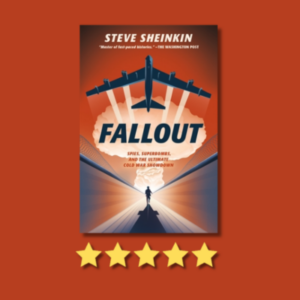
 Published: 2021
Series: Companion to Bomb: The Race to Build—and Steal—the World’s Most Dangerous Weapon
Author: Steve Sheinkin
Genres: Nonfiction, History, Middle Grade, War, Historical, Espionage, Politics, American History
Audience (Grade Levels): Middle School; Grades 6–9
Number of Stars: 5-Star
Goodreads Link: Fallout: Spies, Superbombs, and the Ultimate Cold War Showdown
Triggers: War, geopolitical tension, threat of nuclear annihilation
Review By: Vincent Pillari
Publisher’s Summary:
Author Steve Sheinkin presents a follow up to his award-winning book Bomb: The Race to Build–and Steal–the World’s Most Dangerous Weapon, taking readers on a journey into the Cold War and our mutual assured destruction.
As World War II comes to a close, the United States and the Soviet Union emerge as the two greatest world powers on extreme opposites of the political spectrum. After the United States showed its hand with the atomic bomb in Hiroshima, the Soviets refuse to be left behind. With Communism sweeping the globe, the two nations begin a neck-and-neck competition to build even more destructive bombs and conquer the Space Race. In their battle for dominance, spy planes fly above, armed submarines swim deep below, and undercover agents meet in the dead of night.
The Cold War game grows more precarious as weapons are pointed towards each other, with fingers literally on the trigger. The decades-long showdown culminates in the Cuban Missile Crisis, the world’s close call with the third—and final—world war.
Review:
In Fallout: Spies, Superbombs, and the Ultimate Cold War Showdown, award-winning author Steve Sheinkin delivers a gripping, masterfully researched narrative nonfiction book perfect for middle school students who are eager to dive into the high-stakes chess match of 20th-century history. Serving as a spiritual companion to his acclaimed work Bomb, this book picks up where World War II ends, tracking the neck-and-neck competition between the United States and the Soviet Union. From secret agents meeting in the dead of night to the terrors of the Cuban Missile Crisis, Sheinkin brilliantly outlines how close the world came to mutual assured destruction.
Sheinkin, a master of boiling complex ideas down to engaging narratives, treats readers with the story behind the Cold War. Attacking from all angles, Mr. Sheinkin dives into a world of espionage, atomic weaponry, science, and politics that combined to make the world the ultimate chess board. The product of an incredible amount of research, Fallout walks through the origins of the Cold War, a subject that many peripherally know through pop culture references but few can actually speak in depth about.
What makes this book incredibly memorable is its pacing and characterization. Sheinkin successfully humanizes key figures on both sides of the conflict. Perhaps most surprising is the book’s ability to make our Soviet counterparts relatable as President Kennedy and Nikita Khrushchev square off in the most dangerous game of chicken the world has ever seen. Diving into the psychology of these two world leaders is a fascinating read, especially considering the fact that neither had a direct line of communication during such a gravely serious time. Sheinkin does an amazing job of showing how luck perhaps saved us from world calamity—a thought that reverberates immensely throughout the book.
I highly recommend this book to middle school librarians, history teachers, and any young reader with a passion for history, political thrillers, or spy stories. The narrative flows seamlessly, reading like a fast-paced espionage novel rather than a dry history textbook. Its chief strength lies in how it pulls the iron curtain back and reveals the complex web of stories that had the world on edge for a generation. It is an essential, five-star addition to any school library.
Classroom & Curricular Connections
- Social Studies / US History (The Cold War & Cuban Missile Crisis): This book is an exceptional primary-adjacent text for teaching mid-20th-century history. It traces the origins of geopolitical tension between democratic and communist superpowers, offering a detailed framework for units on the nuclear arms race, the Space Race, and international diplomacy.
- English Language Arts (Narrative Nonfiction): Teachers can utilize Sheinkin’s writing as a prime mentor text for how to transform extensive historical research into a highly suspenseful, character-driven narrative. Educators can analyze how he uses pacing, short chapters, and parallel storylines to build tension.
- Social-Emotional Learning (Decision-Making and Conflict Resolution): The psychological standoff between JFK and Khrushchev provides a unique case study in high-stakes decision-making, showing how communication breakdowns, peer pressure from advisors, and pure chance play a massive role in global conflict resolution.
Readalikes
- Bomb: The Race to Build—and Steal—the World’s Most Dangerous Weapon by Steve Sheinkin
- The Port Chicago 50: Disaster, Mutiny, and the Fight for Civil Rights by Steve Sheinkin
- Spies: The Double Agents Who Helped Win World War II by Marc Favreau