 Published: 2021
Author: Matt de la Peña
Illustrator: Christian Robinson
Genres: Picture Books, Realistic Fiction, Family, Childrens, Art, Fiction, African American, Social Justice, Cultural, Transport
Audience (Grade Levels): PreK–Grade 3
Number of Stars: 5-Stars
Goodreads Link: Milo Imagines the World
Triggers: Parental incarceration (handled with immense gentleness and age-appropriate care)
Review By: Kim LeRoy
Publisher’s Summary
Milo is on a long subway ride with his older sister. To pass the time, he studies the faces around him and makes pictures of their lives. There’s the whiskered man with the crossword puzzle; Milo imagines him playing solitaire in a cluttered apartment full of pets. There’s the wedding-dressed woman with a little dog peeking out of her handbag; Milo imagines her in a grand cathedral ceremony. And then there’s the boy in the suit with the bright white sneakers; Milo imagines him arriving home to a castle with a drawbridge and a butler. But when the boy in the suit gets off on the same stop as Milo–walking the same path, going to the exact same place–Milo realizes that you can’t really know anyone just by looking at them.
Review
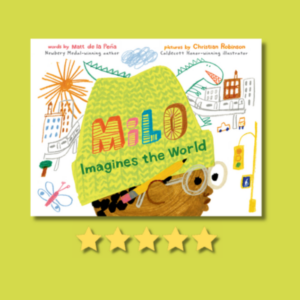
Milo Imagines the World by Matt de la Peña, illustrated by Christian Robinson, is an outstanding and deeply moving picture book aimed at children in PreK through Grade 3. The story follows a young boy named Milo on a long weekly subway ride with his older sister. To pass the time and process his complex feelings, Milo closely observes his fellow passengers and draws intricate, imaginary lives for them in his sketchbook. He imagines a man playing solitaire in a cluttered apartment, a woman in a wedding dress marrying in a grand cathedral, and a boy in a fancy suit living in a majestic castle with a drawbridge. However, when the boy in the suit gets off at the exact same stop as Milo and walks the same path to the exact same destination—a visitation room at a correctional facility—Milo’s perspective shifts completely. He realizes that outward appearances can be incredibly misleading and that everyone carries their own unseen stories.
Kim LeRoy’s review highlights the profound emotional resonance of Milo’s weekly journey. Initially presented as a whimsical adventure of people-watching, the narrative quickly shifts to explore the unconscious biases and assumptions we make about others based entirely on their appearances. De la Peña’s pacing is masterful, building a quiet, rhythmic tension that mirrors the subway ride itself. The emotional peak of the story is both gentle and incredibly powerful, delivering a critical message about empathy without ever feeling preachy or heavy-handed. Christian Robinson’s illustrations are a spectacular highlight; he brilliantly contrasts the clean, painted real-world scenes with Milo’s child-like, colored-pencil sketchbook drawings. This dual artistic style perfectly captures a child’s imaginative inner world and makes Milo’s realizations visually accessible to young readers. Ultimately, this book is an essential, highly recommended addition to any elementary library. It serves as a beautiful, compassionate tool for teaching children to look beyond first impressions and embrace the shared humanity in everyone they meet.
Classroom & Curricular Connections:
- Social-Emotional Learning (Empathy, Assumptions, and Non-Judgment): This book is a premier tool for teaching students that “you can’t judge a book by its cover.” Teachers can use Milo’s realizations to discuss how stereotyping or making snap judgments based on clothing or appearance can prevent us from seeing a person’s true reality.
- Art / Visual Literacy (Mixed Media and Duality of Style): Robinson’s illustrations show a clear contrast between the structured “real world” of the subway and Milo’s raw, child-like sketches. Art teachers can use this text to show how different mediums (paint vs. colored pencil) can convey different perspectives, moods, and layers of reality.
- Social Studies (Community, Diversity, and Public Transportation): The subway setting provides a rich look at urban communities, showcasing a wide demographic of citizens living, traveling, and existing side-by-side.
- “In Our Sketchbooks” Drawing Activity: Provide students with small sketchbooks or folded paper. Ask them to look at a photograph of a person (or select a classmate) and draw a scene depicting what they imagine that person’s favorite hobby, pet, or dream is. Afterward, have students share and discuss how their drawings represent a guess, prompting a conversation on how we can ask kind questions to get to know someone’s real story instead of just guessing.
- “What’s in a Cover?” Book Matching Game: Tie the book’s core theme to library literacy. Wrap several library books in plain brown paper with only a brief, mysterious description written on the front. Have students select a book based on the description rather than the cover, proving that amazing stories are often found beneath unexpected packaging.
Diversity & Representation:
Milo Imagines the World provides groundbreaking, highly necessary representation by gently and realistically depicting a child with an incarcerated parent. Millions of children share this lived experience, yet it is rarely depicted in children’s literature with such warmth, dignity, and lack of shame. Furthermore, the book naturally celebrates a diverse, multicultural urban environment and features a young Black protagonist, making it an invaluable addition to inclusive collections.
Readalikes
- Last Stop on Market Street by Matt de la Peña and Christian Robinson
- Saturday by Oge Mora
- Carmela Full of Wishes by Matt de la Peña and Christian Robinson