 Published: 2026
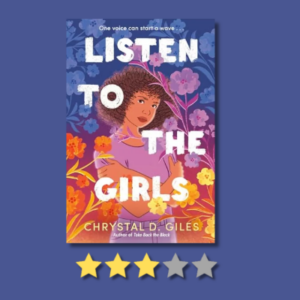
Author: Chrystal D. Giles
Genres: Middle Grade Fiction, Realistic Fiction
Audience (Grade Levels): 6, 7, 8
Number of Stars: 3-Stars
Goodreads Link: Listen to the Girls
Content Notes: Grooming, teacher-student harassment
Review By: Jenna Ballard
Publisher’s Summary
Calla has always had smart-girl energy. She’s Josiah the track star’s practical younger sister. Charlee and Jacoby’s problem-solving best friend. Attorney Dionne Howard’s model daughter. So it’s nice when someone seems to see her for her, outside of all that. But what if that person is a grown-up who maybe isn’t as trustworthy as Calla thought? Calla’s mom likes to say “Always do what you know is right.” But what if you don’t know what the right thing is?
These are the questions Calla faces on the last day of seventh grade, when she finds out that her favorite teacher has been accused of inappropriate conduct at his old school. Calla doesn’t know what really happened. She does know that people are saying mean things about the girls who have spoken out—and that can’t be right . . . can it? Inspired by her favorite newsblogger, EboniNews (whose motto is Amplify. Connect. Truth. ACT.), Calla has an idea. Can she find a way to ACT?
Review
Listen to the Girls by Chrystal D. Giles opens on the last day of Calla’s seventh-grade year. Her bus ride with best friends Jacoby and Charlee feels ordinary, but by English class, whispers are spreading. A blog post has revealed that Mr. Chavis, Calla’s favorite teacher, has been accused of harassing a former student. As classmates debate and speculate, Calla struggles with shock and uncertainty. How could the kind, encouraging teacher she knows be capable of something like this? And what might it mean for her?
For educators and librarians wondering about the subject matter, Giles addresses sexual harassment and grooming frankly while keeping the content appropriate for middle school readers. There is no explicit content. Instead, the novel focuses on Calla’s questions, her shifting understanding of a trusted adult, and the emotional impact of the allegations.
Despite the serious subject, moments of humor and warmth shine through Calla’s friendship with Charlee and Jacoby. Their silly, sweet interactions provide welcome levity, and the characters feel authentic and relatable. Readers who appreciate thoughtful stories about complicated feelings and relationships will find much to consider here.
The pacing, however, may limit its appeal for some students. Much of the conflict is internal as Calla reconsiders her feelings about Mr. Chavis and looks back on past moments. Readers do not see her interacting with him directly. Instead, much of the narration and dialogue centers on characters speculating, sharing information, and worrying about the investigation. Students who prefer fast-moving, action-driven stories may find their interest fading.
Even with that limitation, this novel has a meaningful place in a middle school library. As more information emerges, Calla begins to understand how seemingly harmless comments or behaviors can cross boundaries, especially between an adult and a child. The story gives readers language for recognizing inappropriate behavior and considering why speaking up can be difficult.
An author’s note encourages readers to talk with a trusted adult if they have experienced something similar. School counselors may also find the novel useful for supporting students who connect with Calla’s confusion or sense of betrayal. Overall, Listen to the Girls is a thoughtful, discussion-worthy selection whose strengths lie in its sensitive treatment of difficult questions and its believable emotional experiences.
Classroom & Curricular Connections
- ELA: Analyze internal conflict, characterization, and how an author develops tension through reflection and dialogue. Students can trace how Calla’s understanding changes as new information emerges.
- Health / Social-Emotional Learning: Discuss personal boundaries, trusted adults, and ways to seek help when an interaction feels uncomfortable or confusing.
- Media Literacy: Examine how blog posts, rumors, and peer conversations shape people’s responses to allegations. Explore the difference between verified information and speculation, along with the responsibility to avoid harmful comments about those who speak up.
Readalikes
- Tear This Down by Barbara Dee
- A Good Kind of Trouble by Lisa Moore Ramée
- Dress Coded by Carrie Firestone