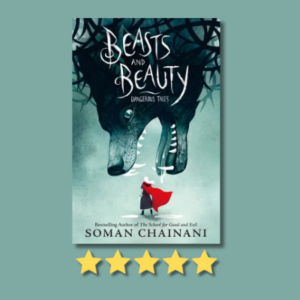
 Published: 2021
Author: Soman Chainani
Genres: Fantasy, Fairy-Tale Retellings, Fiction
Format: Short Story Collection
Audience (Grade Levels): 7, 8, 9, 10, 11, 12, Adult
Number of Stars: 5-Star
Goodreads Link: Beasts and Beauty: Dangerous Tales
Content Notes: Violence, racism, and frightening imagery
Review By: Anonymous
Publisher’s Summary
You think you know these stories, don’t you? You are wrong. You don’t know them at all. Twelve tales, twelve dangerous tales of mystery, magic, and rebellious hearts. Each twists like a spindle to reveal truths full of warning and triumph, truths that capture hearts long kept tame and set them free, truths that explore life . . . and death.
A prince has a surprising awakening . . .
A beauty fights like a beast . . .
A boy refuses to become prey . . .
A path to happiness is lost. . . . then found again.
New York Times bestselling author Soman Chainani respins old stories into fresh fairy tales for a new era and creates a world like no other. These stories know you. They understand you. They reflect you. They are tales for our times. So read on, if you dare.
Review
Oh my – I LOVED this book!!!!! Chainani is a master at creating and rewriting classic stories, in this case, fairy tales. There were so many of the stories that completely blindsided me in the point of view or twists that Chainani incorporated. Truly, inspiring. I bought this book having come across it while researching texts for a Creative Writing course I am building. I knew I wanted to do something with fairy tales and writing or rewriting them, but I wasn’t exactly sure what that would look like, so I was researching for ideas. This book popped up and I was intrigued. Buy this book!!!! That is all I can say, even if you don’t need or plan to use it in your curriculum. It is exceptional! Not knowing what I would do with the book, I started to read the stories to my Creative Writing class to get their feedback on them. They started begging me to read more of the stories. They genuinely were enjoying them and were shocked at some of the twists taken in the stories.
An example – “Sleeping Beauty.” The classic version of this fairy tale has a princess pricking her finger and falling into a deep sleep from which only a prince’s kiss can wake her. So, to have an opening line such as, “To the prince, it was clear: demons were drinking his blood.” is not exactly what one expects as an opening to the story. Chainani does this over and over. He unsettles the reader and leaves them wondering, at a loss as to where he is going to take them as the stories unfold. A brilliant writer. Chainani’s version of “Sleeping Beauty” doesn’t have a princess as the main character. Actually, women are largely lacking in the story. Instead, Chainani gives us a prince as the main character. A prince with nightmares, demons, blood, and horror. The readers are left in awe and dumbstruck, not knowing what is going on or where the story will take them.
Ultimately, each fairy tale has a “focus” or topic that is being addressed. In “Sleeping Beauty” for example, the sleeping beauty is a gay prince who is being visited by his gay lover in what seems to be a vampire sort of apparition. Chainani plays with what beauty is or can be, as well as bringing same sex lovers to mainstream storylines. I love this modern, updated take. Why not read and study what the world looks like all around us? For me and my students, we fell hook, line, and sinker. The mystery of each story, the twists and connections we couldn’t predict left us wanting more. I have added this book to my Creative Writing curriculum. Given my students’ instant addiction to the stories and Chainani’s excellent modeling of how to modernize and shake-up traditional tales, I am using the stories as guides for the students as they write and create their own modernized fairy tales. I think this book is an excellent read in and of itself, but I can also see how it has merit to be included in academic curriculum.
Classroom & Curricular Connections
- ELA / Comparative Literature: Compare a familiar fairy tale with Chainani’s retelling. Examine how changes in character, perspective, and conflict reshape its themes.
- Creative Writing: Study opening lines, unexpected twists, and the manipulation of reader expectations. Discuss how an author can surprise readers while maintaining a coherent story.
- Critical Literacy: Explore whose perspectives traditional tales prioritize and how retellings can challenge assumptions about beauty, power, gender, and love.
- Speaking and Listening: Use selected stories for read-aloud discussions, inviting students to support predictions and interpretations with textual evidence.
- Extension Activity / Library Application: Invite students to create a “Fairy Tale, Reimagined.” After comparing a traditional tale with one of Chainani’s retellings, students can choose a familiar story and change its perspective, central character, setting, or expected resolution. Ask them to include a short author’s note explaining how their changes develop a theme or challenge an assumption in the original.
- Diversity & Representation: The reviewer highlights LGBTQ+ representation, particularly a gay prince at the center of “Sleeping Beauty.” By changing who occupies familiar fairy-tale roles, the collection offers opportunities to examine whose identities and relationships appear in traditional stories and how retellings can broaden those narratives.
Readalikes
- Cruel Truth by Jen Calonita
- The Last Great Heir by Carina Finn
- Nagle trup by Mart Kisiel