 Review By: Anonymous
Published: 2024
Genres: YA Fiction, Contemporary, Novel in Verse
Audience: Grades 7-12, Adult
Goodreads Link: A Second Chance on Earth
Content Warnings: Loss of a parent, mentions of gangs/troubling pasts
Publisher’s Summary
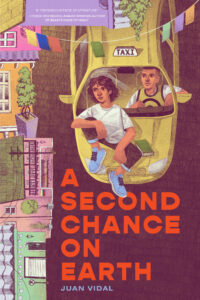
A father, a friend, and a favorite book help a teen boy understand love and loss in this moving and vivid YA novel in verse. For sixteen-year-old poet and b-baller Marcos Cadena, that book is the beat-up copy of One Hundred Years of Solitude he finds among his late father’s possessions after Papi is killed in an accident.
Marcos’ papi has always loomed large in his eyes. So, when Marcos travels to his parents’ childhood home of Cartagena, Colombia to spread Papi’s ashes, he brings his father’s book with him, convinced that Gabriel García Márquez’s masterpiece holds the key to understanding Papi’s life and accepting his death. In Cartagena, Marcos befriends eighteen-year-old Camilo, a taxi driver and fellow García Márquez fan. Together, the two boys explore the landscape of Cartagena, from the picturesque streets of Old Town to the poor neighborhood where Camilo grew up. But when Camilo reveals a troubling secret from his past, Marcos must ask himself whether everyone deserves a second chance.
Review
A Second Chance on Earth by Juan Vidal is a powerful novel in verse that thoughtfully explores grief, identity, and cultural heritage. Staying at his aunt’s house, Marcos begins to uncover pieces of his father’s past including where he grew up, the choices he made, and the life he lived before becoming a parent. This journey allows Marcos to see his father not just as “Papi,” but as a person shaped by place, history, and relationships.
One of the most meaningful elements of the novel is Marcos’ relationship with Camilo, a local taxi driver. Camilo completely transforms Marcos’ experience in the city and helps bridge the gap between past and present, offering Marcos insight into his father’s formative years. The inclusion of One Hundred Years of Solitude by Gabriel García Márquez further deepens this connection, as it becomes a shared text that illuminates the cultural and literary influences that shaped Marcos’ father.
Vidal’s descriptions allow readers to fully experience Cartagena alongside Marcos. From the smells of the city streets to the sights seen from Camilo’s taxi and the warmth of his aunt’s home-cooked meals, the setting feels alive and immersive. These details make the novel especially engaging for students and provide rich opportunities for discussion about culture, memory, and place.